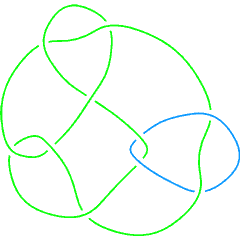
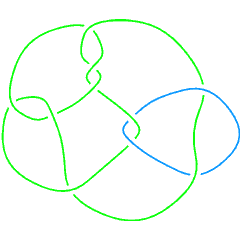
L10a14

From Knot Atlas
Revision as of 18:09, 2 September 2005 by DrorsRobot (talk | contribs)
Jump to navigationJump to search

L10a13.gif

L10a13

L10a15.gif

L10a15

L10a14.gif
(Knotscape image)
See the full Thistlethwaite Link Table (up to 11 crossings).

Visit L10a14 at Knotilus!


Link Presentations

[edit Notes on L10a14's Link Presentations]

Planar diagram presentation X6172 X10,4,11,3 X14,8,15,7 X20,16,5,15 X16,9,17,10 X8,19,9,20 X18,13,19,14 X12,17,13,18 X2536 X4,12,1,11
Gauss code {1, -9, 2, -10}, {9, -1, 3, -6, 5, -2, 10, -8, 7, -3, 4, -5, 8, -7, 6, -4}
A Braid Representative
BraidPart3.gifBraidPart0.gifBraidPart0.gifBraidPart3.gifBraidPart3.gifBraidPart0.gifBraidPart3.gifBraidPart0.gifBraidPart0.gif
BraidPart4.gifBraidPart1.gifBraidPart1.gifBraidPart4.gifBraidPart4.gifBraidPart1.gifBraidPart4.gifBraidPart1.gifBraidPart0.gif
BraidPart0.gifBraidPart2.gifBraidPart2.gifBraidPart3.gifBraidPart0.gifBraidPart2.gifBraidPart0.gifBraidPart2.gifBraidPart3.gif
BraidPart0.gifBraidPart0.gifBraidPart0.gifBraidPart4.gifBraidPart0.gifBraidPart0.gifBraidPart0.gifBraidPart0.gifBraidPart4.gif
A Morse Link Presentation L10a14 ML.gif

Polynomial invariants

Multivariable Alexander Polynomial (in [math]\displaystyle{ u }[/math], [math]\displaystyle{ v }[/math], [math]\displaystyle{ w }[/math], ...) [math]\displaystyle{ \frac{(t(1)-1) (t(2)-1)^3 \left(t(2)^2-t(2)+1\right)}{\sqrt{t(1)} t(2)^{5/2}} }[/math] (db)
Jones polynomial [math]\displaystyle{ -q^{7/2}+4 q^{5/2}-9 q^{3/2}+12 \sqrt{q}-\frac{16}{\sqrt{q}}+\frac{16}{q^{3/2}}-\frac{15}{q^{5/2}}+\frac{12}{q^{7/2}}-\frac{7}{q^{9/2}}+\frac{3}{q^{11/2}}-\frac{1}{q^{13/2}} }[/math] (db)
Signature -1 (db)
HOMFLY-PT polynomial [math]\displaystyle{ a z^7-2 a^3 z^5+4 a z^5-z^5 a^{-1} +a^5 z^3-6 a^3 z^3+7 a z^3-2 z^3 a^{-1} +2 a^5 z-7 a^3 z+7 a z-2 z a^{-1} +a^5 z^{-1} -3 a^3 z^{-1} +4 a z^{-1} -2 a^{-1} z^{-1} }[/math] (db)
Kauffman polynomial [math]\displaystyle{ -2 a^3 z^9-2 a z^9-5 a^4 z^8-12 a^2 z^8-7 z^8-5 a^5 z^7-11 a^3 z^7-14 a z^7-8 z^7 a^{-1} -3 a^6 z^6+3 a^4 z^6+18 a^2 z^6-4 z^6 a^{-2} +8 z^6-a^7 z^5+7 a^5 z^5+30 a^3 z^5+38 a z^5+15 z^5 a^{-1} -z^5 a^{-3} +5 a^6 z^4+5 a^4 z^4-4 a^2 z^4+5 z^4 a^{-2} +z^4+2 a^7 z^3-4 a^5 z^3-28 a^3 z^3-33 a z^3-10 z^3 a^{-1} +z^3 a^{-3} -3 a^6 z^2-7 a^4 z^2-5 a^2 z^2-z^2 a^{-2} -2 z^2-a^7 z+2 a^5 z+13 a^3 z+15 a z+5 z a^{-1} +a^6+3 a^4+3 a^2+2-a^5 z^{-1} -3 a^3 z^{-1} -4 a z^{-1} -2 a^{-1} z^{-1} }[/math] (db)

Khovanov Homology

The coefficients of the monomials [math]\displaystyle{ t^rq^j }[/math] are shown, along with their alternating sums [math]\displaystyle{ \chi }[/math] (fixed [math]\displaystyle{ j }[/math], alternation over [math]\displaystyle{ r }[/math]).   
\ r
  \  
j \
-6-5-4-3-2-101234χ
8          11
6         3 -3
4        61 5
2       63  -3
0      106   4
-2     88    0
-4    78     -1
-6   58      3
-8  27       -5
-10 15        4
-12 2         -2
-141          1
Integral Khovanov Homology

(db, data source)

  
[math]\displaystyle{ \dim{\mathcal G}_{2r+i}\operatorname{KH}^r_{\mathbb Z} }[/math] [math]\displaystyle{ i=-2 }[/math] [math]\displaystyle{ i=0 }[/math]
[math]\displaystyle{ r=-6 }[/math] [math]\displaystyle{ {\mathbb Z} }[/math]
[math]\displaystyle{ r=-5 }[/math] [math]\displaystyle{ {\mathbb Z}^{2}\oplus{\mathbb Z}_2 }[/math] [math]\displaystyle{ {\mathbb Z} }[/math]
[math]\displaystyle{ r=-4 }[/math] [math]\displaystyle{ {\mathbb Z}^{5}\oplus{\mathbb Z}_2^{2} }[/math] [math]\displaystyle{ {\mathbb Z}^{2} }[/math]
[math]\displaystyle{ r=-3 }[/math] [math]\displaystyle{ {\mathbb Z}^{7}\oplus{\mathbb Z}_2^{5} }[/math] [math]\displaystyle{ {\mathbb Z}^{5} }[/math]
[math]\displaystyle{ r=-2 }[/math] [math]\displaystyle{ {\mathbb Z}^{8}\oplus{\mathbb Z}_2^{7} }[/math] [math]\displaystyle{ {\mathbb Z}^{7} }[/math]
[math]\displaystyle{ r=-1 }[/math] [math]\displaystyle{ {\mathbb Z}^{8}\oplus{\mathbb Z}_2^{8} }[/math] [math]\displaystyle{ {\mathbb Z}^{8} }[/math]
[math]\displaystyle{ r=0 }[/math] [math]\displaystyle{ {\mathbb Z}^{8}\oplus{\mathbb Z}_2^{8} }[/math] [math]\displaystyle{ {\mathbb Z}^{10} }[/math]
[math]\displaystyle{ r=1 }[/math] [math]\displaystyle{ {\mathbb Z}^{6}\oplus{\mathbb Z}_2^{6} }[/math] [math]\displaystyle{ {\mathbb Z}^{6} }[/math]
[math]\displaystyle{ r=2 }[/math] [math]\displaystyle{ {\mathbb Z}^{3}\oplus{\mathbb Z}_2^{6} }[/math] [math]\displaystyle{ {\mathbb Z}^{6} }[/math]
[math]\displaystyle{ r=3 }[/math] [math]\displaystyle{ {\mathbb Z}\oplus{\mathbb Z}_2^{3} }[/math] [math]\displaystyle{ {\mathbb Z}^{3} }[/math]
[math]\displaystyle{ r=4 }[/math] [math]\displaystyle{ {\mathbb Z}_2 }[/math] [math]\displaystyle{ {\mathbb Z} }[/math]

Computer Talk

Much of the above data can be recomputed by Mathematica using the package KnotTheory`. See A Sample KnotTheory` Session.

Modifying This Page

Read me first: Modifying Knot Pages

See/edit the Link Page master template (intermediate).

See/edit the Link_Splice_Base (expert).

Back to the top.

L10a13.gif

L10a13

L10a15.gif

L10a15