6 2: Difference between revisions
No edit summary |
No edit summary |
||
| Line 1: | Line 1: | ||
<!-- --> |
<!-- --> |
||
<!-- --> |
|||
<!-- --> |
|||
<!-- --> |
|||
<!-- provide an anchor so we can return to the top of the page --> |
<!-- provide an anchor so we can return to the top of the page --> |
||
<span id="top"></span> |
<span id="top"></span> |
||
<!-- --> |
|||
<!-- this relies on transclusion for next and previous links --> |
<!-- this relies on transclusion for next and previous links --> |
||
{{Knot Navigation Links|ext=gif}} |
{{Knot Navigation Links|ext=gif}} |
||
| ⚫ | |||
{| align=left |
|||
|- valign=top |
|||
|[[Image:{{PAGENAME}}.gif]] |
|||
| ⚫ | |||
|{{:{{PAGENAME}} Quick Notes}} |
|||
|} |
|||
<br style="clear:both" /> |
<br style="clear:both" /> |
||
| Line 24: | Line 21: | ||
{{Vassiliev Invariants}} |
{{Vassiliev Invariants}} |
||
{{Khovanov Homology|table=<table border=1> |
|||
The coefficients of the monomials <math>t^rq^j</math> are shown, along with their alternating sums <math>\chi</math> (fixed <math>j</math>, alternation over <math>r</math>). The squares with <font class=HLYellow>yellow</font> highlighting are those on the "critical diagonals", where <math>j-2r=s+1</math> or <math>j-2r=s+1</math>, where <math>s=</math>{{Data:{{PAGENAME}}/Signature}} is the signature of {{PAGENAME}}. Nonzero entries off the critical diagonals (if any exist) are highlighted in <font class=HLRed>red</font>. |
|||
<center><table border=1> |
|||
<tr align=center> |
<tr align=center> |
||
<td width=18.1818%><table cellpadding=0 cellspacing=0> |
<td width=18.1818%><table cellpadding=0 cellspacing=0> |
||
| Line 44: | Line 37: | ||
<tr align=center><td>-9</td><td bgcolor=yellow> </td><td bgcolor=yellow>1</td><td> </td><td> </td><td> </td><td> </td><td> </td><td>-1</td></tr> |
<tr align=center><td>-9</td><td bgcolor=yellow> </td><td bgcolor=yellow>1</td><td> </td><td> </td><td> </td><td> </td><td> </td><td>-1</td></tr> |
||
<tr align=center><td>-11</td><td bgcolor=yellow>1</td><td> </td><td> </td><td> </td><td> </td><td> </td><td> </td><td>1</td></tr> |
<tr align=center><td>-11</td><td bgcolor=yellow>1</td><td> </td><td> </td><td> </td><td> </td><td> </td><td> </td><td>1</td></tr> |
||
</table> |
</table>}} |
||
{{Computer Talk Header}} |
{{Computer Talk Header}} |
||
| Line 103: | Line 95: | ||
q t</nowiki></pre></td></tr> |
q t</nowiki></pre></td></tr> |
||
</table> |
</table> |
||
[[Category:Knot Page]] |
|||
Revision as of 20:09, 28 August 2005
|
|
|

|
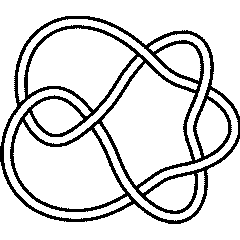
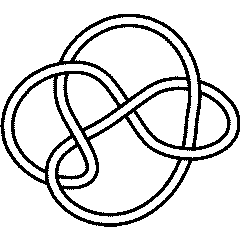
Visit 6 2's page at the Knot Server (KnotPlot driven, includes 3D interactive images!)
Visit 6 2's page at Knotilus! Visit 6 2's page at the original Knot Atlas! Dror likes to call 6_2 "The Miller Institute Knot", as it is the logo of the Miller Institute for Basic Research. The bowline knot of practical knot tying deforms to 6_2. It looks like the crabber's eye knot of practical knot tying deforms to 6_2 also, although the bowline and crabber's eye knot are considered different knots in practical knot tying, given how they are tied, and insofar as how they carry load differently based upon that. |
 The Miller Institute Mug [1] |


Knot presentations
| Planar diagram presentation | X1425 X5,10,6,11 X3948 X9,3,10,2 X7,12,8,1 X11,6,12,7 |
| Gauss code | -1, 4, -3, 1, -2, 6, -5, 3, -4, 2, -6, 5 |
| Dowker-Thistlethwaite code | 4 8 10 12 2 6 |
| Conway Notation | [312] |
Three dimensional invariants
|
Four dimensional invariants
|
Polynomial invariants
| Alexander polynomial | [math]\displaystyle{ -t^2+3 t-3+3 t^{-1} - t^{-2} }[/math] |
| Conway polynomial | [math]\displaystyle{ -z^4-z^2+1 }[/math] |
| 2nd Alexander ideal (db, data sources) | [math]\displaystyle{ \{1\} }[/math] |
| Determinant and Signature | { 11, -2 } |
| Jones polynomial | [math]\displaystyle{ q-1+2 q^{-1} -2 q^{-2} +2 q^{-3} -2 q^{-4} + q^{-5} }[/math] |
| HOMFLY-PT polynomial (db, data sources) | [math]\displaystyle{ z^2 a^4+a^4-z^4 a^2-3 z^2 a^2-2 a^2+z^2+2 }[/math] |
| Kauffman polynomial (db, data sources) | [math]\displaystyle{ z^2 a^6+2 z^3 a^5-z a^5+2 z^4 a^4-2 z^2 a^4+a^4+z^5 a^3-z a^3+3 z^4 a^2-6 z^2 a^2+2 a^2+z^5 a-2 z^3 a+z^4-3 z^2+2 }[/math] |
| The A2 invariant | [math]\displaystyle{ q^{16}-q^8-q^4+q^2+1+ q^{-2} + q^{-4} }[/math] |
| The G2 invariant | [math]\displaystyle{ q^{86}-q^{84}+q^{82}-q^{80}-q^{78}-q^{74}+3 q^{72}-2 q^{70}+q^{68}+2 q^{62}-q^{60}+q^{58}+q^{56}+q^{52}+3 q^{46}-3 q^{44}+q^{42}-q^{40}-q^{38}+2 q^{36}-4 q^{34}+q^{32}-2 q^{30}-3 q^{24}+q^{22}-q^{20}-q^{14}+q^{12}+q^{10}+2 q^6-q^4+2 q^2+1- q^{-2} +3 q^{-4} - q^{-6} +2 q^{-8} - q^{-12} +2 q^{-14} + q^{-18} }[/math] |
A1 Invariants.
| Weight | Invariant |
|---|---|
| 1 | [math]\displaystyle{ q^{11}-q^9+q+ q^{-3} }[/math] |
| 2 | [math]\displaystyle{ q^{30}-q^{28}-q^{26}+2 q^{24}-q^{22}-q^{20}+q^{18}+q^{10}-q^6+q^4+q^2-1+ q^{-2} + q^{-4} - q^{-6} + q^{-10} }[/math] |
| 3 | [math]\displaystyle{ q^{57}-q^{55}-q^{53}+q^{51}+q^{49}-q^{47}-3 q^{45}+2 q^{43}+3 q^{41}-q^{39}-2 q^{37}+q^{35}+2 q^{33}-q^{29}-q^{27}-2 q^{19}-q^{17}+2 q^{15}+2 q^{13}-q^{11}+2 q^7+2 q^5-q^3-2 q+ q^{-1} +2 q^{-3} -2 q^{-7} +2 q^{-11} + q^{-13} - q^{-15} - q^{-17} + q^{-21} }[/math] |
| 4 | [math]\displaystyle{ q^{92}-q^{90}-q^{88}+q^{86}+q^{82}-3 q^{80}-q^{78}+3 q^{76}+2 q^{74}+3 q^{72}-5 q^{70}-4 q^{68}+3 q^{66}+4 q^{64}+3 q^{62}-5 q^{60}-5 q^{58}+2 q^{54}+3 q^{52}-q^{50}-2 q^{48}+q^{44}+2 q^{42}+2 q^{40}+q^{38}-2 q^{36}-2 q^{34}+2 q^{30}+q^{28}-3 q^{26}-3 q^{24}-q^{22}+4 q^{20}+2 q^{18}-3 q^{16}-2 q^{14}+5 q^{10}+3 q^8-2 q^6-2 q^4-2 q^2+4+4 q^{-2} -2 q^{-6} -4 q^{-8} + q^{-10} +3 q^{-12} +2 q^{-14} -4 q^{-18} - q^{-20} + q^{-22} +2 q^{-24} +2 q^{-26} - q^{-28} - q^{-30} - q^{-32} + q^{-36} }[/math] |
| 5 | [math]\displaystyle{ q^{135}-q^{133}-q^{131}+q^{129}-q^{123}-q^{121}+3 q^{117}+4 q^{115}-5 q^{111}-5 q^{109}+4 q^{105}+8 q^{103}+3 q^{101}-8 q^{99}-10 q^{97}-5 q^{95}+5 q^{93}+11 q^{91}+7 q^{89}-2 q^{87}-9 q^{85}-6 q^{83}+q^{81}+6 q^{79}+6 q^{77}+q^{75}-4 q^{73}-5 q^{71}-2 q^{69}+q^{67}+2 q^{65}+3 q^{63}+q^{61}-q^{59}-2 q^{57}-3 q^{55}-q^{53}+3 q^{51}+4 q^{49}+q^{47}-3 q^{45}-5 q^{43}-q^{41}+5 q^{39}+5 q^{37}+q^{35}-4 q^{33}-6 q^{31}-q^{29}+5 q^{27}+6 q^{25}-6 q^{21}-7 q^{19}-2 q^{17}+7 q^{15}+8 q^{13}+3 q^{11}-4 q^9-7 q^7-3 q^5+3 q^3+8 q+6 q^{-1} - q^{-3} -6 q^{-5} -6 q^{-7} -2 q^{-9} +4 q^{-11} +7 q^{-13} +4 q^{-15} - q^{-17} -5 q^{-19} -5 q^{-21} - q^{-23} +3 q^{-25} +5 q^{-27} +3 q^{-29} - q^{-31} -4 q^{-33} -3 q^{-35} - q^{-37} + q^{-39} +3 q^{-41} +2 q^{-43} - q^{-47} - q^{-49} - q^{-51} + q^{-55} }[/math] |
| 6 | [math]\displaystyle{ q^{186}-q^{184}-q^{182}+q^{180}-2 q^{174}+q^{172}+5 q^{166}+2 q^{164}-2 q^{162}-6 q^{160}-3 q^{158}-3 q^{156}+3 q^{154}+12 q^{152}+7 q^{150}-3 q^{148}-14 q^{146}-10 q^{144}-8 q^{142}+4 q^{140}+21 q^{138}+17 q^{136}+5 q^{134}-14 q^{132}-18 q^{130}-17 q^{128}-3 q^{126}+18 q^{124}+20 q^{122}+12 q^{120}-5 q^{118}-13 q^{116}-17 q^{114}-9 q^{112}+7 q^{110}+13 q^{108}+12 q^{106}+2 q^{104}-4 q^{102}-10 q^{100}-9 q^{98}-2 q^{96}+3 q^{94}+6 q^{92}+4 q^{90}+3 q^{88}-q^{86}-3 q^{84}-4 q^{82}-3 q^{80}+4 q^{76}+6 q^{74}+4 q^{72}-6 q^{68}-6 q^{66}-3 q^{64}+5 q^{62}+8 q^{60}+5 q^{58}-q^{56}-11 q^{54}-8 q^{52}-q^{50}+8 q^{48}+9 q^{46}+4 q^{44}-4 q^{42}-14 q^{40}-9 q^{38}+q^{36}+12 q^{34}+12 q^{32}+7 q^{30}-4 q^{28}-16 q^{26}-12 q^{24}-q^{22}+12 q^{20}+14 q^{18}+11 q^{16}-15 q^{12}-15 q^{10}-7 q^8+7 q^6+12 q^4+15 q^2+7-8 q^{-2} -13 q^{-4} -12 q^{-6} -2 q^{-8} +4 q^{-10} +14 q^{-12} +13 q^{-14} +2 q^{-16} -5 q^{-18} -11 q^{-20} -9 q^{-22} -6 q^{-24} +5 q^{-26} +10 q^{-28} +8 q^{-30} +4 q^{-32} -2 q^{-34} -6 q^{-36} -10 q^{-38} -3 q^{-40} +2 q^{-42} +5 q^{-44} +6 q^{-46} +4 q^{-48} + q^{-50} -5 q^{-52} -4 q^{-54} -3 q^{-56} - q^{-58} + q^{-60} +3 q^{-62} +3 q^{-64} - q^{-70} - q^{-72} - q^{-74} + q^{-78} }[/math] |
A2 Invariants.
| Weight | Invariant |
|---|---|
| 1,0 | [math]\displaystyle{ q^{16}-q^8-q^4+q^2+1+ q^{-2} + q^{-4} }[/math] |
| 1,1 | [math]\displaystyle{ q^{44}-2 q^{42}+2 q^{40}-2 q^{38}+5 q^{36}-4 q^{34}+2 q^{32}-4 q^{30}-2 q^{24}+6 q^{22}-4 q^{20}+8 q^{18}-6 q^{16}+6 q^{14}-6 q^{12}+4 q^{10}-2 q^8+q^4-2 q^2+4-4 q^{-2} +4 q^{-4} -2 q^{-6} +4 q^{-8} + q^{-12} }[/math] |
| 2,0 | [math]\displaystyle{ q^{40}-q^{30}-2 q^{28}+q^{20}+2 q^{18}+q^{16}+q^{14}+q^{12}-q^8-q^6-q^2+ q^{-2} + q^{-4} + q^{-8} + q^{-10} + q^{-12} }[/math] |
| 3,0 | [math]\displaystyle{ q^{72}-3 q^{60}-2 q^{58}-q^{56}+2 q^{54}+2 q^{52}+2 q^{46}+4 q^{44}+2 q^{42}-q^{38}-q^{34}-3 q^{32}-4 q^{30}-3 q^{28}-2 q^{26}-q^{24}-q^{22}+2 q^{20}+4 q^{18}+4 q^{16}+3 q^{14}+2 q^{12}+3 q^{10}+q^8-q^6-3 q^4-q^2+1+ q^{-2} - q^{-4} - q^{-6} +2 q^{-10} + q^{-12} - q^{-16} + q^{-20} + q^{-22} + q^{-24} }[/math] |
A3 Invariants.
| Weight | Invariant |
|---|---|
| 0,1,0 | [math]\displaystyle{ q^{36}-q^{34}-q^{32}+q^{30}-q^{28}+2 q^{24}+q^{22}+q^{20}+q^{18}-q^{14}-2 q^{12}-q^{10}-q^8-2 q^6+q^4+2 q^2+1+2 q^{-2} +2 q^{-4} + q^{-8} }[/math] |
| 1,0,0 | [math]\displaystyle{ q^{21}+q^{17}-q^{11}-q^9-q^7-q^5+q^3+q+2 q^{-1} + q^{-3} + q^{-5} }[/math] |
| 1,0,1 | [math]\displaystyle{ q^{58}-2 q^{56}+q^{54}+q^{52}-2 q^{50}+5 q^{48}-2 q^{46}-q^{44}+2 q^{42}-5 q^{40}+3 q^{38}-2 q^{36}-2 q^{34}+3 q^{32}-5 q^{30}+2 q^{28}+q^{26}+4 q^{22}+4 q^{20}+q^{18}+3 q^{16}+2 q^{14}-4 q^{12}+3 q^{10}-7 q^8-q^6-q^4-5 q^2+4-2 q^{-2} +5 q^{-4} +4 q^{-6} +2 q^{-8} +4 q^{-10} + q^{-14} }[/math] |
A4 Invariants.
| Weight | Invariant |
|---|---|
| 0,1,0,0 | [math]\displaystyle{ q^{46}-q^{42}-q^{36}-q^{34}+q^{32}+q^{30}+q^{28}+2 q^{26}+3 q^{24}+q^{22}+q^{18}-2 q^{16}-3 q^{14}-2 q^{12}-2 q^{10}-3 q^8-q^6+q^4+2 q^2+2+3 q^{-2} +3 q^{-4} +2 q^{-6} + q^{-8} + q^{-10} }[/math] |
| 1,0,0,0 | [math]\displaystyle{ q^{26}+q^{22}+q^{20}-q^{14}-q^{12}-2 q^{10}-q^8-q^6+q^4+q^2+2+2 q^{-2} + q^{-4} + q^{-6} }[/math] |
B2 Invariants.
| Weight | Invariant |
|---|---|
| 0,1 | [math]\displaystyle{ q^{36}-q^{34}+q^{32}-q^{30}+q^{28}+q^{22}-q^{20}+q^{18}-2 q^{16}+q^{14}-2 q^{12}+q^{10}-q^8+q^4+1+2 q^{-4} + q^{-8} }[/math] |
| 1,0 | [math]\displaystyle{ q^{58}-q^{54}-q^{52}+q^{48}-q^{44}+q^{40}+q^{38}+q^{32}+q^{30}-q^{26}-q^{18}-q^{16}-q^{10}-q^8+q^6+q^4+q^2+ q^{-4} +2 q^{-6} + q^{-14} }[/math] |
D4 Invariants.
| Weight | Invariant |
|---|---|
| 1,0,0,0 | [math]\displaystyle{ q^{50}-q^{48}-q^{44}+q^{42}-q^{40}+q^{34}+2 q^{32}+q^{30}+2 q^{28}+2 q^{24}-q^{22}-3 q^{18}-q^{16}-3 q^{14}-q^{12}-2 q^{10}-q^8+q^6+q^4+2 q^2+2+3 q^{-2} + q^{-4} +2 q^{-6} + q^{-10} }[/math] |
G2 Invariants.
| Weight | Invariant |
|---|---|
| 1,0 | [math]\displaystyle{ q^{86}-q^{84}+q^{82}-q^{80}-q^{78}-q^{74}+3 q^{72}-2 q^{70}+q^{68}+2 q^{62}-q^{60}+q^{58}+q^{56}+q^{52}+3 q^{46}-3 q^{44}+q^{42}-q^{40}-q^{38}+2 q^{36}-4 q^{34}+q^{32}-2 q^{30}-3 q^{24}+q^{22}-q^{20}-q^{14}+q^{12}+q^{10}+2 q^6-q^4+2 q^2+1- q^{-2} +3 q^{-4} - q^{-6} +2 q^{-8} - q^{-12} +2 q^{-14} + q^{-18} }[/math] |
.
KnotTheory`, as shown in the (simulated) Mathematica session below. Your input (in red) is realistic; all else should have the same content as in a real mathematica session, but with different formatting. This Mathematica session is also available (albeit only for the knot 5_2) as the notebook PolynomialInvariantsSession.nb.
(The path below may be different on your system, and possibly also the KnotTheory` date)
In[1]:=
|
AppendTo[$Path, "C:/drorbn/projects/KAtlas/"];
<< KnotTheory`
|
Loading KnotTheory` version of August 31, 2006, 11:25:27.5625.
|
In[3]:=
|
K = Knot["6 2"];
|
In[4]:=
|
Alexander[K][t]
|
KnotTheory::loading: Loading precomputed data in PD4Knots`.
|
Out[4]=
|
[math]\displaystyle{ -t^2+3 t-3+3 t^{-1} - t^{-2} }[/math] |
In[5]:=
|
Conway[K][z]
|
Out[5]=
|
[math]\displaystyle{ -z^4-z^2+1 }[/math] |
In[6]:=
|
Alexander[K, 2][t]
|
KnotTheory::credits: The program Alexander[K, r] to compute Alexander ideals was written by Jana Archibald at the University of Toronto in the summer of 2005.
|
Out[6]=
|
[math]\displaystyle{ \{1\} }[/math] |
In[7]:=
|
{KnotDet[K], KnotSignature[K]}
|
Out[7]=
|
{ 11, -2 } |
In[8]:=
|
Jones[K][q]
|
KnotTheory::loading: Loading precomputed data in Jones4Knots`.
|
Out[8]=
|
[math]\displaystyle{ q-1+2 q^{-1} -2 q^{-2} +2 q^{-3} -2 q^{-4} + q^{-5} }[/math] |
In[9]:=
|
HOMFLYPT[K][a, z]
|
KnotTheory::credits: The HOMFLYPT program was written by Scott Morrison.
|
Out[9]=
|
[math]\displaystyle{ z^2 a^4+a^4-z^4 a^2-3 z^2 a^2-2 a^2+z^2+2 }[/math] |
In[10]:=
|
Kauffman[K][a, z]
|
KnotTheory::loading: Loading precomputed data in Kauffman4Knots`.
|
Out[10]=
|
[math]\displaystyle{ z^2 a^6+2 z^3 a^5-z a^5+2 z^4 a^4-2 z^2 a^4+a^4+z^5 a^3-z a^3+3 z^4 a^2-6 z^2 a^2+2 a^2+z^5 a-2 z^3 a+z^4-3 z^2+2 }[/math] |
Vassiliev invariants
| V2 and V3: | (-1, 1) |
| V2,1 through V6,9: |
|
V2,1 through V6,9 were provided by Petr Dunin-Barkowski <barkovs@itep.ru>, Andrey Smirnov <asmirnov@itep.ru>, and Alexei Sleptsov <sleptsov@itep.ru> and uploaded on October 2010 by User:Drorbn. Note that they are normalized differently than V2 and V3.
Khovanov Homology
| The coefficients of the monomials [math]\displaystyle{ t^rq^j }[/math] are shown, along with their alternating sums [math]\displaystyle{ \chi }[/math] (fixed [math]\displaystyle{ j }[/math], alternation over [math]\displaystyle{ r }[/math]). The squares with yellow highlighting are those on the "critical diagonals", where [math]\displaystyle{ j-2r=s+1 }[/math] or [math]\displaystyle{ j-2r=s-1 }[/math], where [math]\displaystyle{ s= }[/math]-2 is the signature of 6 2. Nonzero entries off the critical diagonals (if any exist) are highlighted in red. |
|
| Integral Khovanov Homology
(db, data source) |
|
Computer Talk
Much of the above data can be recomputed by Mathematica using the package KnotTheory`. See A Sample KnotTheory` Session.
[math]\displaystyle{ \textrm{Include}(\textrm{ColouredJonesM.mhtml}) }[/math]
In[1]:= |
<< KnotTheory` |
Loading KnotTheory` (version of August 17, 2005, 14:44:34)... | |
In[2]:= | Crossings[Knot[6, 2]] |
Out[2]= | 6 |
In[3]:= | PD[Knot[6, 2]] |
Out[3]= | PD[X[1, 4, 2, 5], X[5, 10, 6, 11], X[3, 9, 4, 8], X[9, 3, 10, 2], X[7, 12, 8, 1], X[11, 6, 12, 7]] |
In[4]:= | GaussCode[Knot[6, 2]] |
Out[4]= | GaussCode[-1, 4, -3, 1, -2, 6, -5, 3, -4, 2, -6, 5] |
In[5]:= | BR[Knot[6, 2]] |
Out[5]= | BR[3, {-1, -1, -1, 2, -1, 2}] |
In[6]:= | alex = Alexander[Knot[6, 2]][t] |
Out[6]= | -2 3 2 |
In[7]:= | Conway[Knot[6, 2]][z] |
Out[7]= | 2 4 1 - z - z |
In[8]:= | Select[AllKnots[], (alex === Alexander[#][t])&] |
Out[8]= | {Knot[6, 2]} |
In[9]:= | {KnotDet[Knot[6, 2]], KnotSignature[Knot[6, 2]]} |
Out[9]= | {11, -2} |
In[10]:= | J=Jones[Knot[6, 2]][q] |
Out[10]= | -5 2 2 2 2 |
In[11]:= | Select[AllKnots[], (J === Jones[#][q] || (J /. q-> 1/q) === Jones[#][q])&] |
Out[11]= | {Knot[6, 2]} |
In[12]:= | A2Invariant[Knot[6, 2]][q] |
Out[12]= | -16 -8 -4 -2 2 4 1 + q - q - q + q + q + q |
In[13]:= | Kauffman[Knot[6, 2]][a, z] |
Out[13]= | 2 4 3 5 2 2 2 4 2 6 2 |
In[14]:= | {Vassiliev[2][Knot[6, 2]], Vassiliev[3][Knot[6, 2]]} |
Out[14]= | {0, 1} |
In[15]:= | Kh[Knot[6, 2]][q, t] |
Out[15]= | -3 2 1 1 1 1 1 1 1 t |
