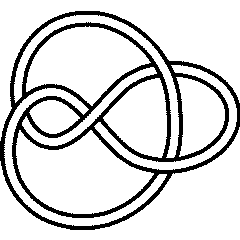
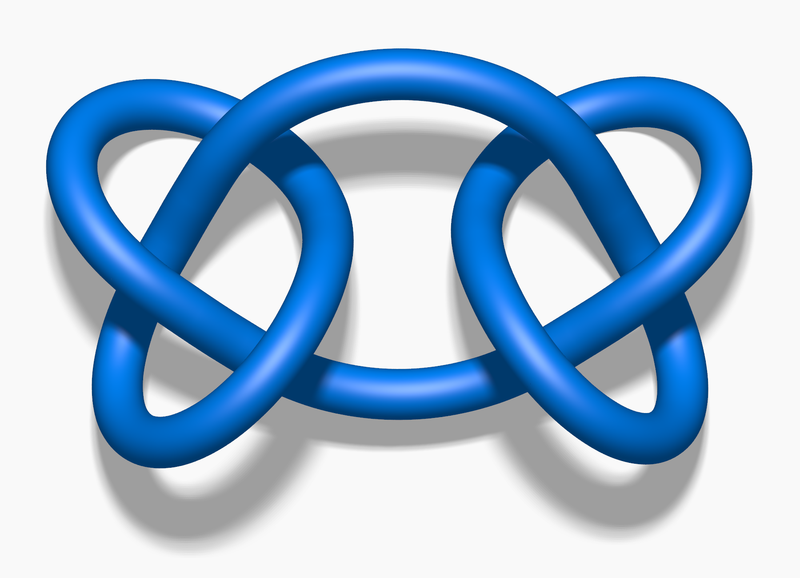
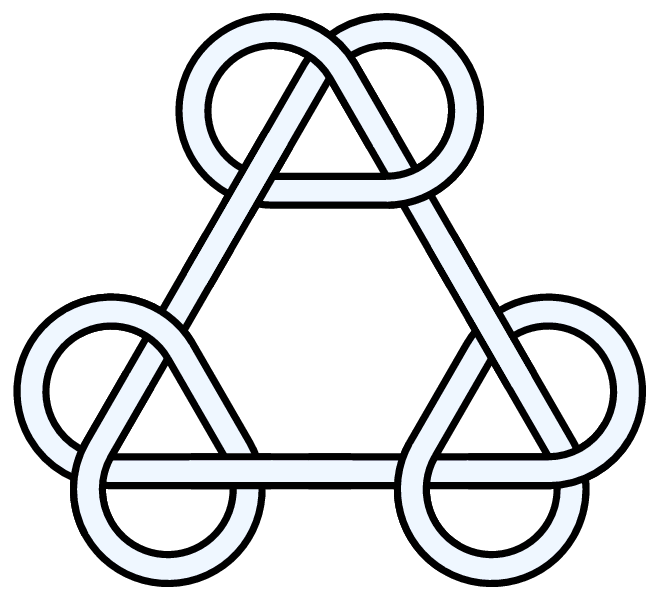
The trefoil is perhaps the easiest knot to find in "nature", and is topologically equivalent to the interlaced form of the common Christian and pagan "triquetra" symbol [12]:
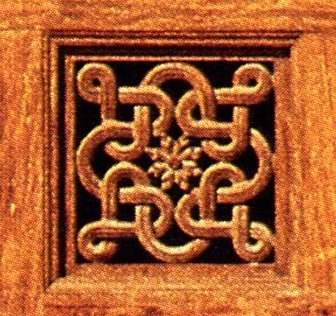
 Logo of Caixa Geral de Depositos, Lisboa [1] |
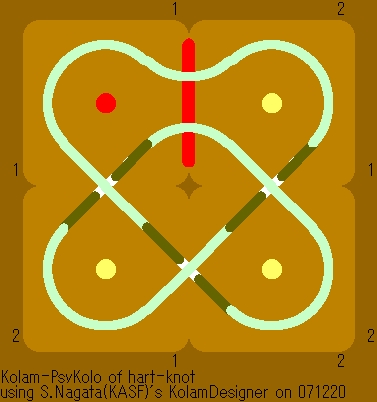 A knot consists of two harts in Kolam [2] |
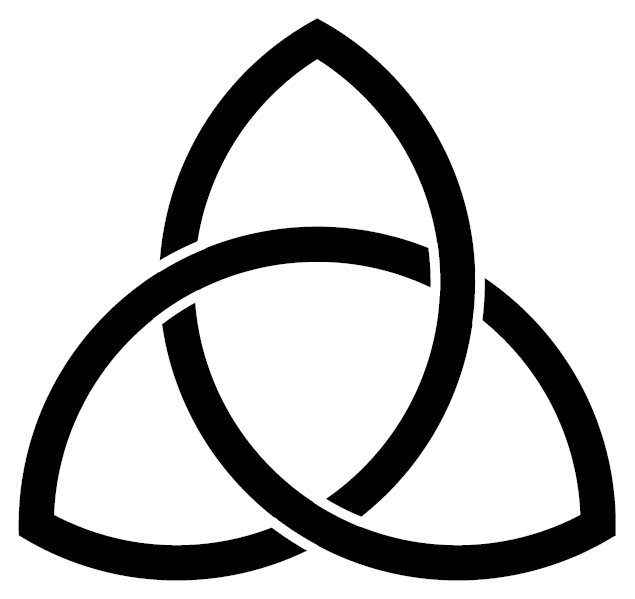 A basic form of the interlaced Triquetra; as a Christian symbol, it refers to the Trinity |
|
Further images...
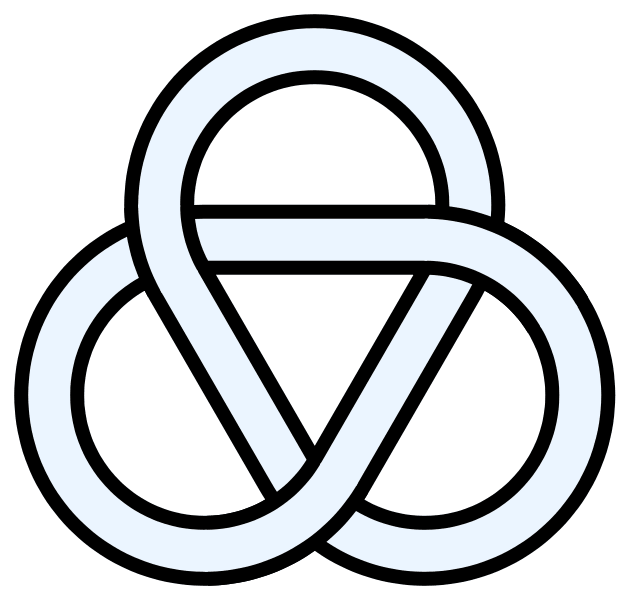 Trefoil/triquetra without outside corners (made from straight lines and 240° circular arcs) |
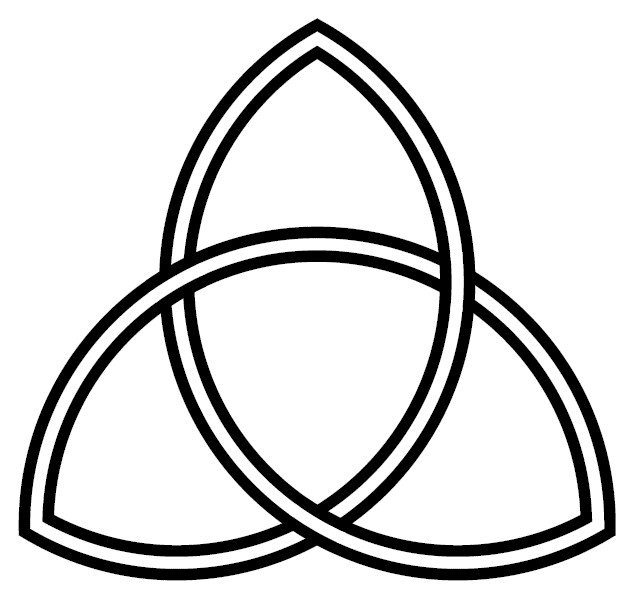 Triquetra made from circular arc ribbons |
|
|
|
|
 A trefoil near the Hollander York Gallery [4] |
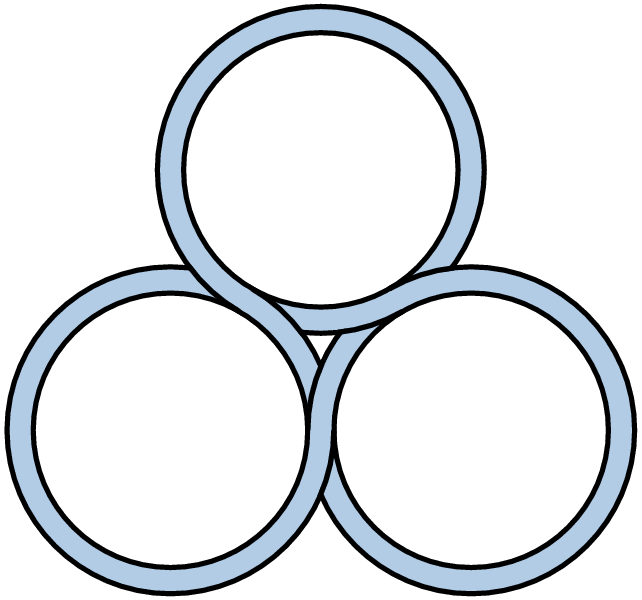 Trefoil of three intersecting circles |
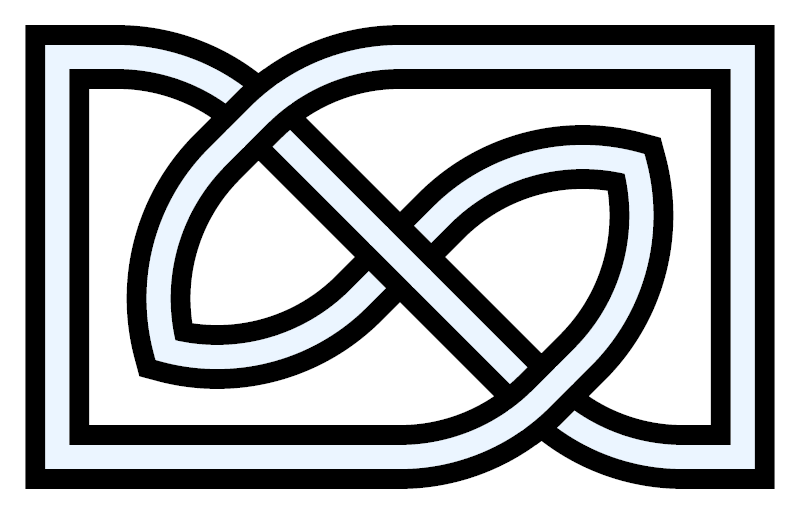 Trefoil depicted in non-threefold form |
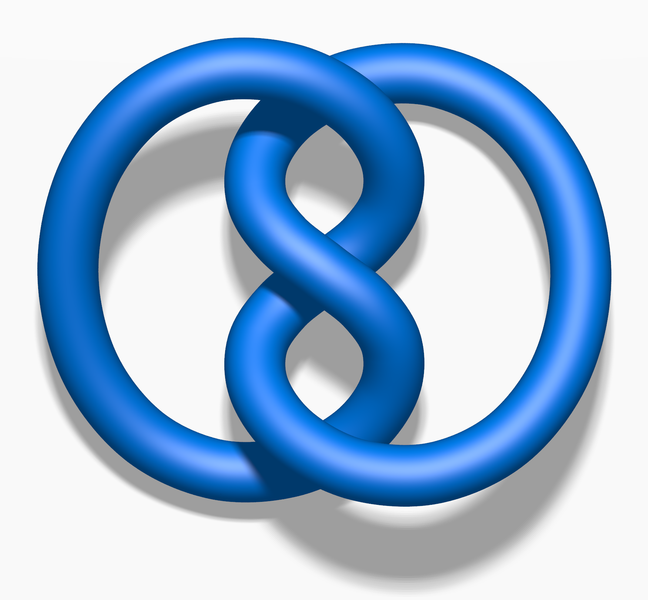 3D depiction in non-threefold form |
 A hagfish tying itself in a knot to escape capture. [5] |
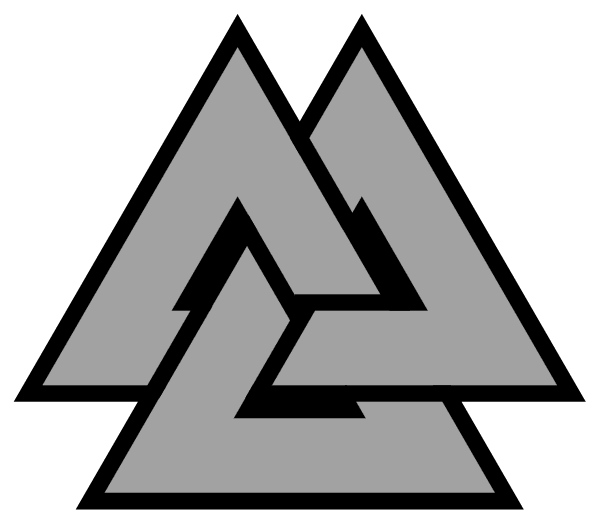 One version of the Germanic "Valknut" symbol |
|
|
|
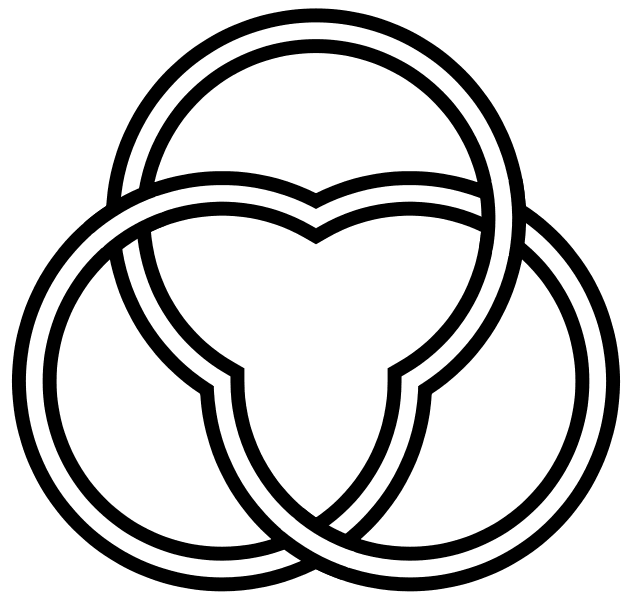 In the form of an architectural trefoil |
|
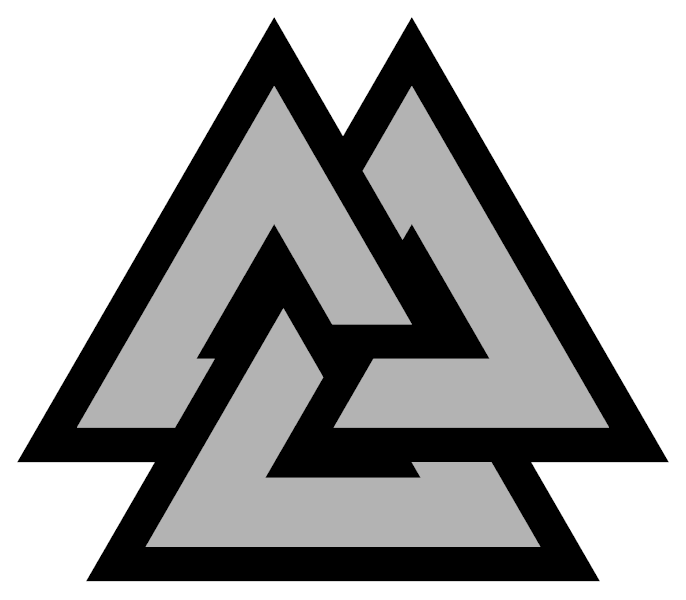 Alternate Valknut depiction |
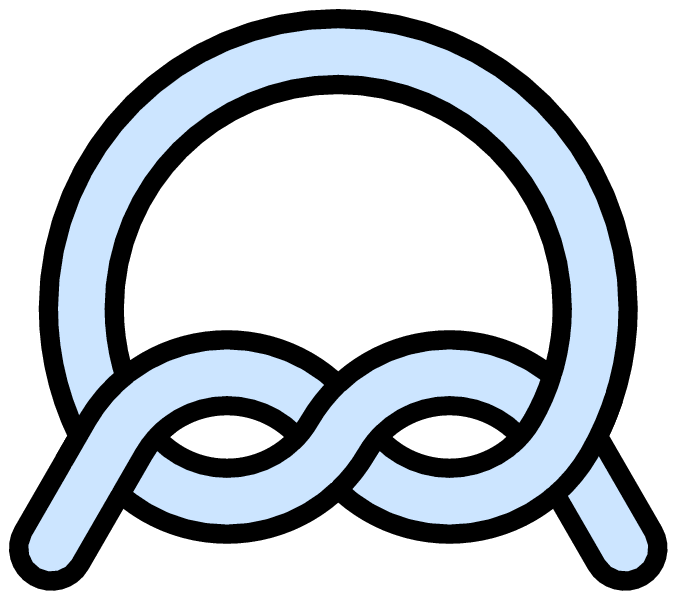 Simple overhand knot of practical knot-tying |
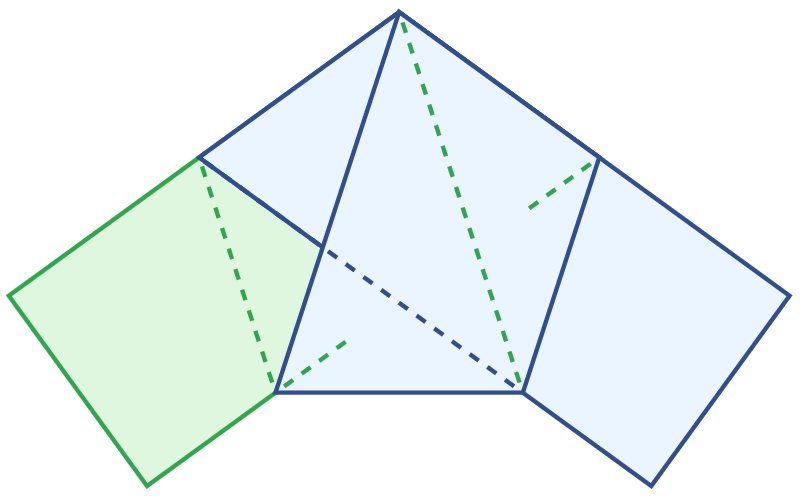 Tightly folded pentagonal overhand knot |
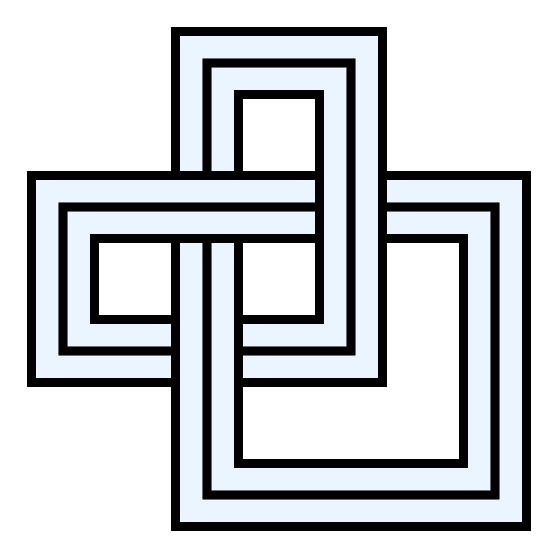 Visually fancier square trefoil |
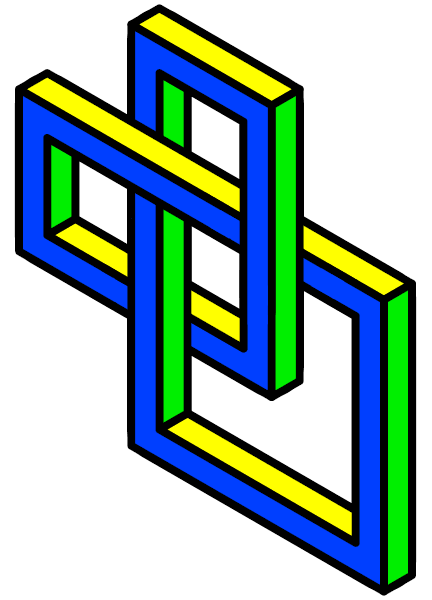 Trefoil knot as impossible object |
 Logo of the Caixa Geral de Depósitos with white background |
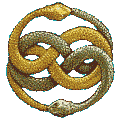 The NeverEnding Story logo is a connected sum of two trefoils. [7] |
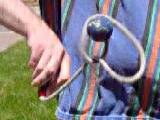 Mike Hutchings' Rope Trick [8] |
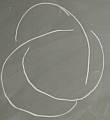 Thurston's Trefoil - Figure Eight Trick [9] |
|
|
|
Non-prime (compound) versions
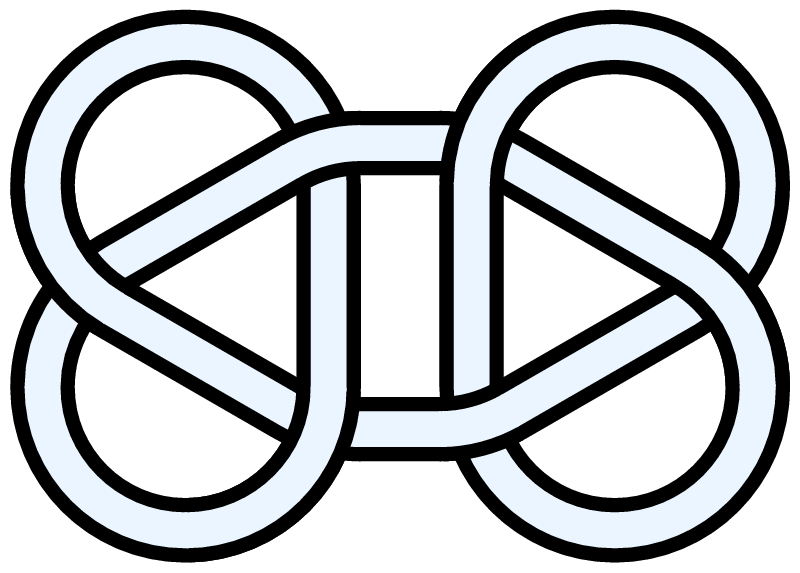
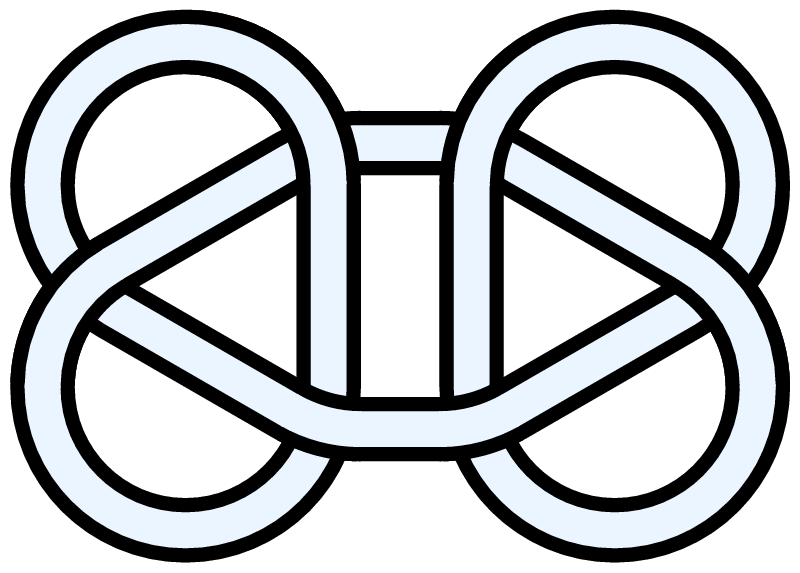
Two trefoils (single-closed-loop version of the "granny knot" of practical knot-tying).
Two trefoils (single-closed-loop version of the "square knot" of practical knot-tying)
Three trefoils (symmetrical).
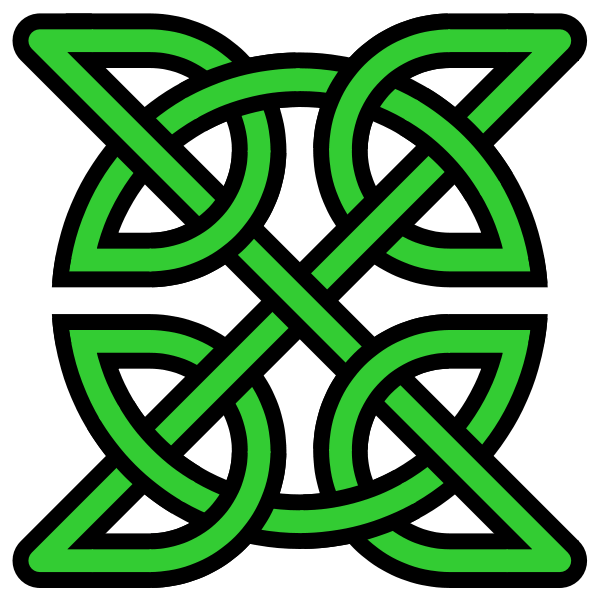
Four trefoils (Celtic or pseudo-Celtic decorative knot which fits in square)
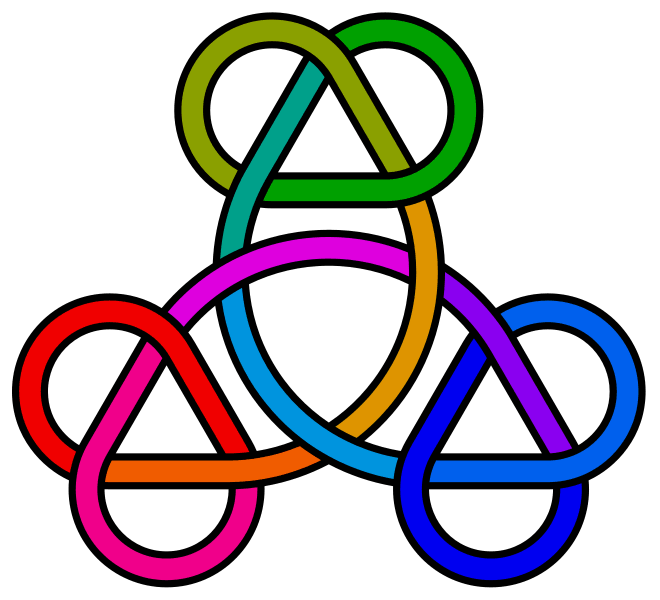
Three trefoils along a closed loop which itself is knotted as a trefoil.
Sum of four trefoils, Multan, Pakistan
For configurations of two trefoils along a closed loop which are prime, see 8_15 and 10_120. For a configuration of three trefoils along a closed loop which is prime, see K13a248. For a prime link consisting of two joined trefoils, see L10a108.
Knot presentations
| Minimum Braid Representative
|
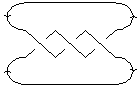
A Morse Link Presentation
|
An Arc Presentation
|
Length is 3, width is 2,
Braid index is 2
|
|
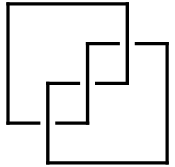
[{5, 2}, {1, 3}, {2, 4}, {3, 5}, {4, 1}]
|
[edit Notes on presentations of 3 1]
|
|
|
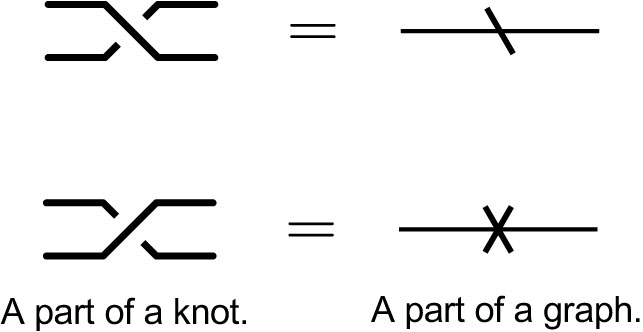 A part of a knot and a part of a graph. |
Computer Talk
The above data is available with the
Mathematica package
KnotTheory`. Your input (in
red) is realistic; all else should have the same content as in a real mathematica session, but with different formatting.
(The path below may be different on your system, and possibly also the KnotTheory` date)
In[1]:=
|
AppendTo[$Path, "C:/drorbn/projects/KAtlas/"];
<< KnotTheory`
|
|
|
KnotTheory::loading: Loading precomputed data in PD4Knots`.
|
Out[4]=
|
X1425 X3641 X5263
|
Out[5]=
|
-1, 3, -2, 1, -3, 2
|
(The path below may be different on your system)
In[7]:=
|
AppendTo[$Path, "C:/bin/LinKnot/"];
|
In[8]:=
|
ConwayNotation[K]
|
|
|
KnotTheory::credits: The minimum braids representing the knots with up to 10 crossings were provided by Thomas Gittings. See arXiv:math.GT/0401051.
|
Out[9]=
|
[math]\displaystyle{ \textrm{BR}(2,\{-1,-1,-1\}) }[/math]
|
In[10]:=
|
{First[br], Crossings[br], BraidIndex[K]}
|
|
|
KnotTheory::loading: Loading precomputed data in IndianaData`.
|
In[11]:=
|
Show[BraidPlot[br]]
|
In[12]:=
|
Show[DrawMorseLink[K]]
|
|
|
KnotTheory::credits: "MorseLink was added to KnotTheory` by Siddarth Sankaran at the University of Toronto in the summer of 2005."
|
|
|
KnotTheory::credits: "DrawMorseLink was written by Siddarth Sankaran at the University of Toronto in the summer of 2005."
|
In[13]:=
|
ap = ArcPresentation[K]
|
Out[13]=
|
ArcPresentation[{5, 2}, {1, 3}, {2, 4}, {3, 5}, {4, 1}]
|
Four dimensional invariants
| Smooth 4 genus
|
[math]\displaystyle{ 1 }[/math]
|
| Topological 4 genus
|
[math]\displaystyle{ 1 }[/math]
|
| Concordance genus
|
[math]\displaystyle{ \textrm{ConcordanceGenus}(\textrm{Knot}(3,1)) }[/math]
|
| Rasmussen s-Invariant
|
-2
|
|
[edit Notes for 3 1's four dimensional invariants]
|
Polynomial invariants
Further Quantum Invariants
Further quantum knot invariants for 3_1.
The braid index of 3_1 is only 2, so it's easy to calculate lots of quantum invariants.
A1 Invariants.
| Weight
|
Invariant
|
| 1
|
[math]\displaystyle{ -q^9+q^5+q^3+q }[/math]
|
| 2
|
[math]\displaystyle{ q^{24}-q^{20}-q^{18}-q^{16}+q^{10}+q^8+q^6+q^4+q^2 }[/math]
|
| 3
|
[math]\displaystyle{ -q^{45}+q^{41}+q^{39}+q^{37}-q^{31}-q^{29}-q^{27}-q^{25}-q^{23}+q^{15}+q^{13}+q^{11}+q^9+q^7+q^5+q^3 }[/math]
|
| 4
|
[math]\displaystyle{ q^{72}-q^{68}-q^{66}-q^{64}+q^{58}+q^{56}+q^{54}+q^{52}+q^{50}-q^{42}-q^{40}-q^{38}-q^{36}-q^{34}-q^{32}-q^{30}+q^{20}+q^{18}+q^{16}+q^{14}+q^{12}+q^{10}+q^8+q^6+q^4 }[/math]
|
| 5
|
[math]\displaystyle{ -q^{105}+q^{101}+q^{99}+q^{97}-q^{91}-q^{89}-q^{87}-q^{85}-q^{83}+q^{75}+q^{73}+q^{71}+q^{69}+q^{67}+q^{65}+q^{63}-q^{53}-q^{51}-q^{49}-q^{47}-q^{45}-q^{43}-q^{41}-q^{39}-q^{37}+q^{25}+q^{23}+q^{21}+q^{19}+q^{17}+q^{15}+q^{13}+q^{11}+q^9+q^7+q^5 }[/math]
|
| 6
|
[math]\displaystyle{ q^{144}-q^{140}-q^{138}-q^{136}+q^{130}+q^{128}+q^{126}+q^{124}+q^{122}-q^{114}-q^{112}-q^{110}-q^{108}-q^{106}-q^{104}-q^{102}+q^{92}+q^{90}+q^{88}+q^{86}+q^{84}+q^{82}+q^{80}+q^{78}+q^{76}-q^{64}-q^{62}-q^{60}-q^{58}-q^{56}-q^{54}-q^{52}-q^{50}-q^{48}-q^{46}-q^{44}+q^{30}+q^{28}+q^{26}+q^{24}+q^{22}+q^{20}+q^{18}+q^{16}+q^{14}+q^{12}+q^{10}+q^8+q^6 }[/math]
|
| 8
|
[math]\displaystyle{ q^{240}-q^{236}-q^{234}-q^{232}+q^{226}+q^{224}+q^{222}+q^{220}+q^{218}-q^{210}-q^{208}-q^{206}-q^{204}-q^{202}-q^{200}-q^{198}+q^{188}+q^{186}+q^{184}+q^{182}+q^{180}+q^{178}+q^{176}+q^{174}+q^{172}-q^{160}-q^{158}-q^{156}-q^{154}-q^{152}-q^{150}-q^{148}-q^{146}-q^{144}-q^{142}-q^{140}+q^{126}+q^{124}+q^{122}+q^{120}+q^{118}+q^{116}+q^{114}+q^{112}+q^{110}+q^{108}+q^{106}+q^{104}+q^{102}-q^{86}-q^{84}-q^{82}-q^{80}-q^{78}-q^{76}-q^{74}-q^{72}-q^{70}-q^{68}-q^{66}-q^{64}-q^{62}-q^{60}-q^{58}+q^{40}+q^{38}+q^{36}+q^{34}+q^{32}+q^{30}+q^{28}+q^{26}+q^{24}+q^{22}+q^{20}+q^{18}+q^{16}+q^{14}+q^{12}+q^{10}+q^8 }[/math]
|
A2 Invariants.
| Weight
|
Invariant
|
| 0,1
|
[math]\displaystyle{ -q^{14}-q^{12}+q^8+2 q^6+q^4+q^2 }[/math]
|
| 0,2
|
[math]\displaystyle{ q^{34}+q^{32}+q^{30}-q^{28}-2 q^{26}-3 q^{24}-3 q^{22}-q^{20}+2 q^{16}+2 q^{14}+3 q^{12}+2 q^{10}+2 q^8+q^6+q^4 }[/math]
|
| 1,0
|
[math]\displaystyle{ -q^{14}-q^{12}+q^8+2 q^6+q^4+q^2 }[/math]
|
| 1,1
|
[math]\displaystyle{ q^{36}-2 q^{24}-2 q^{22}-3 q^{20}-2 q^{18}+2 q^{14}+3 q^{12}+4 q^{10}+4 q^8+2 q^6+q^4 }[/math]
|
| 2,0
|
[math]\displaystyle{ q^{34}+q^{32}+q^{30}-q^{28}-2 q^{26}-3 q^{24}-3 q^{22}-q^{20}+2 q^{16}+2 q^{14}+3 q^{12}+2 q^{10}+2 q^8+q^6+q^4 }[/math]
|
| 3,0
|
[math]\displaystyle{ -q^{60}-q^{58}-q^{56}+2 q^{52}+3 q^{50}+4 q^{48}+3 q^{46}+2 q^{44}-q^{42}-3 q^{40}-5 q^{38}-5 q^{36}-5 q^{34}-4 q^{32}-2 q^{30}-q^{28}+q^{26}+2 q^{24}+3 q^{22}+3 q^{20}+4 q^{18}+3 q^{16}+3 q^{14}+2 q^{12}+2 q^{10}+q^8+q^6 }[/math]
|
A3 Invariants.
| Weight
|
Invariant
|
| 0,0,1
|
[math]\displaystyle{ -q^{19}-q^{17}-q^{15}+q^{11}+2 q^9+2 q^7+q^5+q^3 }[/math]
|
| 0,1,0
|
[math]\displaystyle{ q^{30}-q^{24}-2 q^{22}-2 q^{20}-2 q^{18}+q^{14}+3 q^{12}+3 q^{10}+3 q^8+q^6+q^4 }[/math]
|
| 1,0,0
|
[math]\displaystyle{ -q^{19}-q^{17}-q^{15}+q^{11}+2 q^9+2 q^7+q^5+q^3 }[/math]
|
| 1,0,1
|
[math]\displaystyle{ q^{48}+q^{38}+q^{36}+q^{34}-q^{32}-3 q^{30}-5 q^{28}-6 q^{26}-6 q^{24}-3 q^{22}+q^{20}+4 q^{18}+7 q^{16}+8 q^{14}+7 q^{12}+5 q^{10}+2 q^8+q^6 }[/math]
|
A4 Invariants.
| Weight
|
Invariant
|
| 0,0,0,1
|
[math]\displaystyle{ -q^{24}-q^{22}-q^{20}-q^{18}+q^{14}+2 q^{12}+2 q^{10}+2 q^8+q^6+q^4 }[/math]
|
| 0,1,0,0
|
[math]\displaystyle{ q^{40}+q^{38}+q^{36}-q^{32}-3 q^{30}-4 q^{28}-4 q^{26}-3 q^{24}-q^{22}+q^{20}+4 q^{18}+4 q^{16}+5 q^{14}+4 q^{12}+3 q^{10}+q^8+q^6 }[/math]
|
| 1,0,0,0
|
[math]\displaystyle{ -q^{24}-q^{22}-q^{20}-q^{18}+q^{14}+2 q^{12}+2 q^{10}+2 q^8+q^6+q^4 }[/math]
|
A5 Invariants.
| Weight
|
Invariant
|
| 0,0,0,0,1
|
[math]\displaystyle{ -q^{29}-q^{27}-q^{25}-q^{23}-q^{21}+q^{17}+2 q^{15}+2 q^{13}+2 q^{11}+2 q^9+q^7+q^5 }[/math]
|
| 1,0,0,0,0
|
[math]\displaystyle{ -q^{29}-q^{27}-q^{25}-q^{23}-q^{21}+q^{17}+2 q^{15}+2 q^{13}+2 q^{11}+2 q^9+q^7+q^5 }[/math]
|
A6 Invariants.
| Weight
|
Invariant
|
| 0,0,0,0,0,1
|
[math]\displaystyle{ -q^{34}-q^{32}-q^{30}-q^{28}-q^{26}-q^{24}+q^{20}+2 q^{18}+2 q^{16}+2 q^{14}+2 q^{12}+2 q^{10}+q^8+q^6 }[/math]
|
| 1,0,0,0,0,0
|
[math]\displaystyle{ -q^{34}-q^{32}-q^{30}-q^{28}-q^{26}-q^{24}+q^{20}+2 q^{18}+2 q^{16}+2 q^{14}+2 q^{12}+2 q^{10}+q^8+q^6 }[/math]
|
B2 Invariants.
| Weight
|
Invariant
|
| 0,1
|
[math]\displaystyle{ -q^{30}-q^{24}+q^{14}+q^{12}+q^{10}+q^8+q^6+q^4 }[/math]
|
| 1,0
|
[math]\displaystyle{ q^{48}-q^{38}-q^{36}-q^{34}-q^{32}-q^{30}-q^{28}+q^{22}+q^{20}+2 q^{18}+q^{16}+2 q^{14}+q^{12}+q^{10}+q^6 }[/math]
|
B3 Invariants.
| Weight
|
Invariant
|
| 1,0,0
|
[math]\displaystyle{ q^{72}-q^{58}-q^{54}-q^{52}-q^{50}-q^{48}-q^{46}-q^{44}-q^{42}+q^{34}+2 q^{30}+q^{28}+2 q^{26}+q^{24}+2 q^{22}+q^{20}+2 q^{18}+q^{14}+q^{10} }[/math]
|
B4 Invariants.
| Weight
|
Invariant
|
| 1,0,0,0
|
[math]\displaystyle{ q^{96}-q^{78}-q^{74}-q^{70}-q^{68}-q^{66}-q^{64}-q^{62}-q^{60}-q^{58}-q^{54}+q^{46}+2 q^{42}+2 q^{38}+q^{36}+2 q^{34}+q^{32}+2 q^{30}+q^{28}+2 q^{26}+2 q^{22}+q^{18}+q^{14} }[/math]
|
B5 Invariants.
| Weight
|
Invariant
|
| 1,0,0,0,0
|
[math]\displaystyle{ q^{120}-q^{98}-q^{94}-q^{90}-q^{86}-q^{84}-q^{82}-q^{80}-q^{78}-q^{76}-q^{74}-q^{70}-q^{66}+q^{58}+2 q^{54}+2 q^{50}+2 q^{46}+q^{44}+2 q^{42}+q^{40}+2 q^{38}+q^{36}+2 q^{34}+2 q^{30}+2 q^{26}+q^{22}+q^{18} }[/math]
|
C3 Invariants.
| Weight
|
Invariant
|
| 1,0,0
|
[math]\displaystyle{ -q^{42}-q^{34}-q^{32}-q^{24}+q^{20}+2 q^{18}+q^{16}+q^{14}+q^{12}+2 q^{10}+q^8+q^6 }[/math]
|
C4 Invariants.
| Weight
|
Invariant
|
| 1,0,0,0
|
[math]\displaystyle{ -q^{54}-q^{44}-q^{42}-q^{40}-q^{32}-q^{30}+q^{26}+2 q^{24}+2 q^{22}+q^{20}+q^{18}+q^{16}+2 q^{14}+2 q^{12}+q^{10}+q^8 }[/math]
|
D4 Invariants.
| Weight
|
Invariant
|
| 0,1,0,0
|
[math]\displaystyle{ q^{72}-q^{64}-q^{62}+2 q^{56}+4 q^{54}+5 q^{52}+4 q^{50}+3 q^{48}-q^{46}-5 q^{44}-9 q^{42}-13 q^{40}-14 q^{38}-13 q^{36}-9 q^{34}-4 q^{32}+2 q^{30}+7 q^{28}+12 q^{26}+12 q^{24}+14 q^{22}+11 q^{20}+9 q^{18}+6 q^{16}+4 q^{14}+q^{12}+q^{10} }[/math]
|
| 1,0,0,0
|
[math]\displaystyle{ q^{42}-q^{34}-q^{32}-2 q^{30}-2 q^{28}-2 q^{26}-q^{24}+q^{20}+2 q^{18}+3 q^{16}+3 q^{14}+3 q^{12}+2 q^{10}+q^8+q^6 }[/math]
|
G2 Invariants.
| Weight
|
Invariant
|
| 0,1
|
[math]\displaystyle{ q^{144}-q^{126}+q^{122}-q^{116}+2 q^{112}+q^{110}-q^{108}+2 q^{104}+q^{102}-q^{98}-q^{96}+q^{94}-2 q^{90}-2 q^{88}-q^{86}-q^{84}-2 q^{82}-3 q^{80}-2 q^{78}-2 q^{76}-2 q^{74}-2 q^{72}-2 q^{70}-q^{68}-q^{64}-q^{62}+q^{60}+q^{58}+q^{56}+2 q^{54}+q^{52}+2 q^{50}+3 q^{48}+2 q^{46}+2 q^{44}+3 q^{42}+2 q^{40}+2 q^{38}+3 q^{36}+2 q^{34}+q^{32}+2 q^{30}+q^{28}+q^{26}+q^{24}+q^{18} }[/math]
|
| 1,0
|
[math]\displaystyle{ q^{72}-q^{64}-q^{62}-q^{56}-2 q^{54}-q^{52}+q^{50}-q^{46}-2 q^{44}+2 q^{40}+q^{38}-q^{36}+2 q^{32}+2 q^{30}+q^{28}+2 q^{22}+2 q^{20}+q^{14}+q^{12}+q^{10} }[/math]
|
.
Computer Talk
The above data is available with the
Mathematica package
KnotTheory`, as shown in the (simulated) Mathematica session below. Your input (in
red) is realistic; all else should have the same content as in a real mathematica session, but with different formatting. This Mathematica session is also available (albeit only for the knot
5_2) as the notebook
PolynomialInvariantsSession.nb.
(The path below may be different on your system, and possibly also the KnotTheory` date)
In[1]:=
|
AppendTo[$Path, "C:/drorbn/projects/KAtlas/"];
<< KnotTheory`
|
|
|
KnotTheory::loading: Loading precomputed data in PD4Knots`.
|
Out[4]=
|
[math]\displaystyle{ t+ t^{-1} -1 }[/math]
|
Out[5]=
|
[math]\displaystyle{ z^2+1 }[/math]
|
In[6]:=
|
Alexander[K, 2][t]
|
|
|
KnotTheory::credits: The program Alexander[K, r] to compute Alexander ideals was written by Jana Archibald at the University of Toronto in the summer of 2005.
|
Out[6]=
|
[math]\displaystyle{ \{1\} }[/math]
|
In[7]:=
|
{KnotDet[K], KnotSignature[K]}
|
|
|
KnotTheory::loading: Loading precomputed data in Jones4Knots`.
|
Out[8]=
|
[math]\displaystyle{ - q^{-4} + q^{-3} + q^{-1} }[/math]
|
In[9]:=
|
HOMFLYPT[K][a, z]
|
|
|
KnotTheory::credits: The HOMFLYPT program was written by Scott Morrison.
|
Out[9]=
|
[math]\displaystyle{ -a^4+a^2 z^2+2 a^2 }[/math]
|
In[10]:=
|
Kauffman[K][a, z]
|
|
|
KnotTheory::loading: Loading precomputed data in Kauffman4Knots`.
|
Out[10]=
|
[math]\displaystyle{ a^5 z+a^4 z^2-a^4+a^3 z+a^2 z^2-2 a^2 }[/math]
|
"Similar" Knots (within the Atlas)
Same Alexander/Conway Polynomial:
{}
Same Jones Polynomial (up to mirroring, [math]\displaystyle{ q\leftrightarrow q^{-1} }[/math]):
{}
Computer Talk
The above data is available with the
Mathematica package
KnotTheory`. Your input (in
red) is realistic; all else should have the same content as in a real mathematica session, but with different formatting.
(The path below may be different on your system, and possibly also the KnotTheory` date)
In[1]:=
|
AppendTo[$Path, "C:/drorbn/projects/KAtlas/"];
<< KnotTheory`
|
In[4]:=
|
{A = Alexander[K][t], J = Jones[K][q]}
|
|
|
KnotTheory::loading: Loading precomputed data in PD4Knots`.
|
|
|
KnotTheory::loading: Loading precomputed data in Jones4Knots`.
|
Out[4]=
|
{ [math]\displaystyle{ t+ t^{-1} -1 }[/math], [math]\displaystyle{ - q^{-4} + q^{-3} + q^{-1} }[/math] }
|
In[5]:=
|
DeleteCases[Select[AllKnots[], (A === Alexander[#][t]) &], K]
|
|
|
KnotTheory::loading: Loading precomputed data in DTCode4KnotsTo11`.
|
|
|
KnotTheory::credits: The GaussCode to PD conversion was written by Siddarth Sankaran at the University of Toronto in the summer of 2005.
|
In[6]:=
|
DeleteCases[
  Select[
    AllKnots[],
    (J === Jones[#][q] || (J /. q -> 1/q) === Jones[#][q]) &
    ],
  K
  ]
|
|
|
KnotTheory::loading: Loading precomputed data in Jones4Knots11`.
|
| V2,1 through V6,9:
|
| V2,1
|
V3,1
|
V4,1
|
V4,2
|
V4,3
|
V5,1
|
V5,2
|
V5,3
|
V5,4
|
V6,1
|
V6,2
|
V6,3
|
V6,4
|
V6,5
|
V6,6
|
V6,7
|
V6,8
|
V6,9
|
| [math]\displaystyle{ 4 }[/math]
|
[math]\displaystyle{ -8 }[/math]
|
[math]\displaystyle{ 8 }[/math]
|
[math]\displaystyle{ \frac{62}{3} }[/math]
|
[math]\displaystyle{ \frac{10}{3} }[/math]
|
[math]\displaystyle{ -32 }[/math]
|
[math]\displaystyle{ -\frac{176}{3} }[/math]
|
[math]\displaystyle{ -\frac{32}{3} }[/math]
|
[math]\displaystyle{ -8 }[/math]
|
[math]\displaystyle{ \frac{32}{3} }[/math]
|
[math]\displaystyle{ 32 }[/math]
|
[math]\displaystyle{ \frac{248}{3} }[/math]
|
[math]\displaystyle{ \frac{40}{3} }[/math]
|
[math]\displaystyle{ \frac{5071}{30} }[/math]
|
[math]\displaystyle{ \frac{58}{15} }[/math]
|
[math]\displaystyle{ \frac{3062}{45} }[/math]
|
[math]\displaystyle{ \frac{17}{18} }[/math]
|
[math]\displaystyle{ \frac{271}{30} }[/math]
|
|
V2,1 through V6,9 were provided by Petr Dunin-Barkowski <barkovs@itep.ru>, Andrey Smirnov <asmirnov@itep.ru>, and Alexei Sleptsov <sleptsov@itep.ru> and uploaded on October 2010 by User:Drorbn. Note that they are normalized differently than V2 and V3.
| The coefficients of the monomials [math]\displaystyle{ t^rq^j }[/math] are shown, along with their alternating sums [math]\displaystyle{ \chi }[/math] (fixed [math]\displaystyle{ j }[/math], alternation over [math]\displaystyle{ r }[/math]). The squares with yellow highlighting are those on the "critical diagonals", where [math]\displaystyle{ j-2r=s+1 }[/math] or [math]\displaystyle{ j-2r=s-1 }[/math], where [math]\displaystyle{ s= }[/math]-2 is the signature of 3 1. Nonzero entries off the critical diagonals (if any exist) are highlighted in red.
|
|
|
-3 | -2 | -1 | 0 | χ |
| -1 | | | | 1 | 1 |
| -3 | | | | 1 | 1 |
| -5 | | 1 | | | 1 |
| -7 | | | | | 0 |
| -9 | 1 | | | | -1 |
|
| Integral Khovanov Homology
(db, data source)
|
|
| [math]\displaystyle{ \dim{\mathcal G}_{2r+i}\operatorname{KH}^r_{\mathbb Z} }[/math]
|
[math]\displaystyle{ i=-3 }[/math]
|
[math]\displaystyle{ i=-1 }[/math]
|
| [math]\displaystyle{ r=-3 }[/math]
|
[math]\displaystyle{ {\mathbb Z} }[/math]
|
|
| [math]\displaystyle{ r=-2 }[/math]
|
[math]\displaystyle{ {\mathbb Z}_2 }[/math]
|
[math]\displaystyle{ {\mathbb Z} }[/math]
|
| [math]\displaystyle{ r=-1 }[/math]
|
|
|
| [math]\displaystyle{ r=0 }[/math]
|
[math]\displaystyle{ {\mathbb Z} }[/math]
|
[math]\displaystyle{ {\mathbb Z} }[/math]
|
|
The Coloured Jones Polynomials
| [math]\displaystyle{ n }[/math]
|
[math]\displaystyle{ J_n }[/math]
|
| 2
|
[math]\displaystyle{ q^{-2} + q^{-5} - q^{-7} + q^{-8} - q^{-9} - q^{-10} + q^{-11} }[/math]
|
| 3
|
[math]\displaystyle{ q^{-3} + q^{-7} - q^{-10} + q^{-11} - q^{-13} - q^{-14} + q^{-15} - q^{-17} + q^{-19} + q^{-20} - q^{-21} }[/math]
|
| 4
|
[math]\displaystyle{ q^{-4} + q^{-9} - q^{-13} + q^{-14} - q^{-17} - q^{-18} + q^{-19} - q^{-22} - q^{-23} +2 q^{-24} - q^{-28} +2 q^{-29} - q^{-32} - q^{-33} + q^{-34} }[/math]
|
| 5
|
[math]\displaystyle{ q^{-5} + q^{-11} - q^{-16} + q^{-17} - q^{-21} - q^{-22} + q^{-23} - q^{-27} - q^{-28} + q^{-29} + q^{-30} - q^{-33} + q^{-35} + q^{-36} - q^{-39} + q^{-42} - q^{-44} - q^{-45} + q^{-48} + q^{-49} - q^{-50} }[/math]
|
| 6
|
[math]\displaystyle{ q^{-6} + q^{-13} - q^{-19} + q^{-20} - q^{-25} - q^{-26} + q^{-27} - q^{-32} - q^{-33} + q^{-34} + q^{-36} - q^{-39} - q^{-40} +2 q^{-41} + q^{-43} - q^{-46} - q^{-47} +2 q^{-48} - q^{-53} -2 q^{-54} +2 q^{-55} - q^{-60} - q^{-61} +2 q^{-62} + q^{-64} - q^{-67} - q^{-68} + q^{-69} }[/math]
|
| 7
|
[math]\displaystyle{ q^{-7} + q^{-15} - q^{-22} + q^{-23} - q^{-29} - q^{-30} + q^{-31} - q^{-37} - q^{-38} + q^{-39} + q^{-42} - q^{-45} - q^{-46} + q^{-47} + q^{-48} + q^{-50} - q^{-53} - q^{-54} + q^{-55} + q^{-56} + q^{-58} - q^{-59} - q^{-61} - q^{-62} + q^{-63} + q^{-66} - q^{-67} - q^{-69} - q^{-70} + q^{-71} + q^{-73} + q^{-74} - q^{-75} - q^{-78} + q^{-79} + q^{-81} + q^{-82} - q^{-83} - q^{-84} - q^{-86} + q^{-89} + q^{-90} - q^{-91} }[/math]
|