8 10: Difference between revisions
No edit summary |
No edit summary |
||
| Line 1: | Line 1: | ||
<!-- --> |
<!-- --> |
||
<!-- --> |
|||
<!-- --> |
|||
<!-- --> |
|||
<!-- provide an anchor so we can return to the top of the page --> |
<!-- provide an anchor so we can return to the top of the page --> |
||
<span id="top"></span> |
<span id="top"></span> |
||
<!-- --> |
|||
<!-- this relies on transclusion for next and previous links --> |
<!-- this relies on transclusion for next and previous links --> |
||
{{Knot Navigation Links|ext=gif}} |
{{Knot Navigation Links|ext=gif}} |
||
| ⚫ | |||
{| align=left |
|||
|- valign=top |
|||
|[[Image:{{PAGENAME}}.gif]] |
|||
| ⚫ | |||
|{{:{{PAGENAME}} Quick Notes}} |
|||
|} |
|||
<br style="clear:both" /> |
<br style="clear:both" /> |
||
| Line 24: | Line 21: | ||
{{Vassiliev Invariants}} |
{{Vassiliev Invariants}} |
||
{{Khovanov Homology|table=<table border=1> |
|||
The coefficients of the monomials <math>t^rq^j</math> are shown, along with their alternating sums <math>\chi</math> (fixed <math>j</math>, alternation over <math>r</math>). The squares with <font class=HLYellow>yellow</font> highlighting are those on the "critical diagonals", where <math>j-2r=s+1</math> or <math>j-2r=s+1</math>, where <math>s=</math>{{Data:{{PAGENAME}}/Signature}} is the signature of {{PAGENAME}}. Nonzero entries off the critical diagonals (if any exist) are highlighted in <font class=HLRed>red</font>. |
|||
<center><table border=1> |
|||
<tr align=center> |
<tr align=center> |
||
<td width=15.3846%><table cellpadding=0 cellspacing=0> |
<td width=15.3846%><table cellpadding=0 cellspacing=0> |
||
| Line 46: | Line 39: | ||
<tr align=center><td>-3</td><td bgcolor=yellow> </td><td bgcolor=yellow>1</td><td> </td><td> </td><td> </td><td> </td><td> </td><td> </td><td> </td><td>1</td></tr> |
<tr align=center><td>-3</td><td bgcolor=yellow> </td><td bgcolor=yellow>1</td><td> </td><td> </td><td> </td><td> </td><td> </td><td> </td><td> </td><td>1</td></tr> |
||
<tr align=center><td>-5</td><td bgcolor=yellow>1</td><td> </td><td> </td><td> </td><td> </td><td> </td><td> </td><td> </td><td> </td><td>-1</td></tr> |
<tr align=center><td>-5</td><td bgcolor=yellow>1</td><td> </td><td> </td><td> </td><td> </td><td> </td><td> </td><td> </td><td> </td><td>-1</td></tr> |
||
</table> |
</table>}} |
||
{{Computer Talk Header}} |
{{Computer Talk Header}} |
||
| Line 117: | Line 109: | ||
3 q t + 2 q t + q t + 3 q t + q t + q t + q t</nowiki></pre></td></tr> |
3 q t + 2 q t + q t + 3 q t + q t + q t + q t</nowiki></pre></td></tr> |
||
</table> |
</table> |
||
[[Category:Knot Page]] |
|||
Revision as of 20:07, 28 August 2005
|
|
|
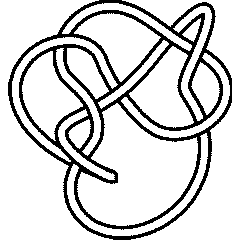
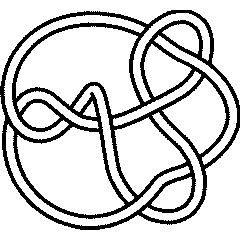

|
Visit 8 10's page at the Knot Server (KnotPlot driven, includes 3D interactive images!)
Visit 8 10's page at Knotilus! Visit 8 10's page at the original Knot Atlas! |
Knot presentations
| Planar diagram presentation | X1425 X3849 X9,15,10,14 X5,13,6,12 X13,7,14,6 X11,1,12,16 X15,11,16,10 X7283 |
| Gauss code | -1, 8, -2, 1, -4, 5, -8, 2, -3, 7, -6, 4, -5, 3, -7, 6 |
| Dowker-Thistlethwaite code | 4 8 12 2 14 16 6 10 |
| Conway Notation | [3,21,2] |
Three dimensional invariants
|
Four dimensional invariants
|
Polynomial invariants
| Alexander polynomial | [math]\displaystyle{ t^3-3 t^2+6 t-7+6 t^{-1} -3 t^{-2} + t^{-3} }[/math] |
| Conway polynomial | [math]\displaystyle{ z^6+3 z^4+3 z^2+1 }[/math] |
| 2nd Alexander ideal (db, data sources) | [math]\displaystyle{ \{1\} }[/math] |
| Determinant and Signature | { 27, 2 } |
| Jones polynomial | [math]\displaystyle{ -q^6+2 q^5-4 q^4+5 q^3-4 q^2+5 q-3+2 q^{-1} - q^{-2} }[/math] |
| HOMFLY-PT polynomial (db, data sources) | [math]\displaystyle{ z^6 a^{-2} +5 z^4 a^{-2} -z^4 a^{-4} -z^4+9 z^2 a^{-2} -3 z^2 a^{-4} -3 z^2+6 a^{-2} -3 a^{-4} -2 }[/math] |
| Kauffman polynomial (db, data sources) | [math]\displaystyle{ z^7 a^{-1} +z^7 a^{-3} +5 z^6 a^{-2} +3 z^6 a^{-4} +2 z^6+a z^5+z^5 a^{-1} +3 z^5 a^{-3} +3 z^5 a^{-5} -13 z^4 a^{-2} -5 z^4 a^{-4} +2 z^4 a^{-6} -6 z^4-3 a z^3-8 z^3 a^{-1} -9 z^3 a^{-3} -3 z^3 a^{-5} +z^3 a^{-7} +12 z^2 a^{-2} +6 z^2 a^{-4} -z^2 a^{-6} +5 z^2+2 a z+5 z a^{-1} +6 z a^{-3} +2 z a^{-5} -z a^{-7} -6 a^{-2} -3 a^{-4} -2 }[/math] |
| The A2 invariant | [math]\displaystyle{ -q^6-q^2+2 q^{-2} + q^{-4} +4 q^{-6} + q^{-8} + q^{-10} - q^{-12} -2 q^{-14} - q^{-18} }[/math] |
| The G2 invariant | [math]\displaystyle{ q^{32}-q^{30}+3 q^{28}-4 q^{26}+2 q^{24}-q^{22}-5 q^{20}+9 q^{18}-12 q^{16}+10 q^{14}-6 q^{12}-5 q^{10}+12 q^8-16 q^6+14 q^4-9 q^2-2+9 q^{-2} -13 q^{-4} +9 q^{-6} - q^{-8} -4 q^{-10} +12 q^{-12} -7 q^{-14} +3 q^{-16} +7 q^{-18} -10 q^{-20} +19 q^{-22} -14 q^{-24} +9 q^{-26} +7 q^{-28} -12 q^{-30} +23 q^{-32} -19 q^{-34} +14 q^{-36} - q^{-38} -7 q^{-40} +13 q^{-42} -17 q^{-44} +11 q^{-46} - q^{-48} -7 q^{-50} +8 q^{-52} -8 q^{-54} -2 q^{-56} +8 q^{-58} -14 q^{-60} +9 q^{-62} -6 q^{-64} -3 q^{-66} +9 q^{-68} -14 q^{-70} +14 q^{-72} -8 q^{-74} +2 q^{-76} +2 q^{-78} -7 q^{-80} +6 q^{-82} -6 q^{-84} +5 q^{-86} -2 q^{-88} + q^{-92} -2 q^{-94} +2 q^{-96} - q^{-98} + q^{-100} }[/math] |
A1 Invariants.
| Weight | Invariant |
|---|---|
| 1 | [math]\displaystyle{ -q^5+q^3-q+2 q^{-1} + q^{-3} + q^{-5} + q^{-7} -2 q^{-9} + q^{-11} - q^{-13} }[/math] |
| 2 | [math]\displaystyle{ q^{16}-q^{14}-2 q^{12}+3 q^{10}-5 q^6+3 q^4+3 q^2-5+2 q^{-2} +5 q^{-4} -2 q^{-6} +4 q^{-10} + q^{-12} -2 q^{-14} - q^{-16} +4 q^{-18} -4 q^{-20} -4 q^{-22} +6 q^{-24} -2 q^{-26} -4 q^{-28} +3 q^{-30} - q^{-34} + q^{-36} }[/math] |
| 3 | [math]\displaystyle{ -q^{33}+q^{31}+2 q^{29}-4 q^{25}-2 q^{23}+6 q^{21}+5 q^{19}-6 q^{17}-10 q^{15}+3 q^{13}+13 q^{11}+q^9-15 q^7-6 q^5+12 q^3+12 q-11 q^{-1} -11 q^{-3} +8 q^{-5} +16 q^{-7} -3 q^{-9} -13 q^{-11} +2 q^{-13} +14 q^{-15} + q^{-17} -10 q^{-19} -3 q^{-21} +6 q^{-23} +8 q^{-25} -4 q^{-27} -11 q^{-29} -4 q^{-31} +14 q^{-33} +6 q^{-35} -13 q^{-37} -13 q^{-39} +13 q^{-41} +13 q^{-43} -10 q^{-45} -13 q^{-47} +4 q^{-49} +11 q^{-51} - q^{-53} -6 q^{-55} + q^{-57} +3 q^{-59} - q^{-63} + q^{-67} - q^{-69} }[/math] |
| 4 | [math]\displaystyle{ q^{56}-q^{54}-2 q^{52}+q^{48}+6 q^{46}-6 q^{42}-6 q^{40}-4 q^{38}+15 q^{36}+12 q^{34}-2 q^{32}-16 q^{30}-25 q^{28}+9 q^{26}+26 q^{24}+24 q^{22}-4 q^{20}-45 q^{18}-22 q^{16}+11 q^{14}+45 q^{12}+32 q^{10}-33 q^8-46 q^6-26 q^4+37 q^2+60+ q^{-2} -40 q^{-4} -49 q^{-6} +13 q^{-8} +60 q^{-10} +25 q^{-12} -26 q^{-14} -52 q^{-16} - q^{-18} +46 q^{-20} +28 q^{-22} -16 q^{-24} -42 q^{-26} -9 q^{-28} +27 q^{-30} +29 q^{-32} -4 q^{-34} -30 q^{-36} -22 q^{-38} +5 q^{-40} +32 q^{-42} +21 q^{-44} -7 q^{-46} -40 q^{-48} -31 q^{-50} +28 q^{-52} +46 q^{-54} +27 q^{-56} -41 q^{-58} -66 q^{-60} +3 q^{-62} +48 q^{-64} +55 q^{-66} -17 q^{-68} -64 q^{-70} -19 q^{-72} +21 q^{-74} +50 q^{-76} +10 q^{-78} -32 q^{-80} -19 q^{-82} -4 q^{-84} +22 q^{-86} +10 q^{-88} -7 q^{-90} -3 q^{-92} -6 q^{-94} +4 q^{-96} +2 q^{-98} -2 q^{-100} + q^{-102} -2 q^{-104} + q^{-106} - q^{-110} + q^{-112} }[/math] |
| 5 | [math]\displaystyle{ -q^{85}+q^{83}+2 q^{81}-q^{77}-3 q^{75}-4 q^{73}+8 q^{69}+8 q^{67}+2 q^{65}-7 q^{63}-16 q^{61}-14 q^{59}+4 q^{57}+26 q^{55}+29 q^{53}+10 q^{51}-23 q^{49}-49 q^{47}-39 q^{45}+7 q^{43}+59 q^{41}+71 q^{39}+31 q^{37}-43 q^{35}-97 q^{33}-82 q^{31}+2 q^{29}+98 q^{27}+127 q^{25}+61 q^{23}-66 q^{21}-153 q^{19}-129 q^{17}+2 q^{15}+149 q^{13}+181 q^{11}+66 q^9-107 q^7-208 q^5-143 q^3+53 q+209 q^{-1} +185 q^{-3} +16 q^{-5} -176 q^{-7} -215 q^{-9} -60 q^{-11} +146 q^{-13} +214 q^{-15} +94 q^{-17} -100 q^{-19} -198 q^{-21} -105 q^{-23} +78 q^{-25} +170 q^{-27} +104 q^{-29} -55 q^{-31} -147 q^{-33} -93 q^{-35} +40 q^{-37} +124 q^{-39} +82 q^{-41} -32 q^{-43} -108 q^{-45} -81 q^{-47} +14 q^{-49} +92 q^{-51} +84 q^{-53} +12 q^{-55} -69 q^{-57} -102 q^{-59} -55 q^{-61} +46 q^{-63} +112 q^{-65} +105 q^{-67} +9 q^{-69} -122 q^{-71} -164 q^{-73} -60 q^{-75} +104 q^{-77} +204 q^{-79} +139 q^{-81} -71 q^{-83} -236 q^{-85} -193 q^{-87} +11 q^{-89} +218 q^{-91} +241 q^{-93} +50 q^{-95} -176 q^{-97} -246 q^{-99} -100 q^{-101} +113 q^{-103} +213 q^{-105} +131 q^{-107} -46 q^{-109} -160 q^{-111} -128 q^{-113} + q^{-115} +98 q^{-117} +99 q^{-119} +27 q^{-121} -47 q^{-123} -64 q^{-125} -31 q^{-127} +17 q^{-129} +32 q^{-131} +20 q^{-133} - q^{-135} -13 q^{-137} -12 q^{-139} -4 q^{-141} +6 q^{-143} +5 q^{-145} - q^{-151} -2 q^{-153} + q^{-155} +2 q^{-157} - q^{-159} + q^{-163} - q^{-165} }[/math] |
| 6 | [math]\displaystyle{ q^{120}-q^{118}-2 q^{116}+q^{112}+3 q^{110}+q^{108}+4 q^{106}-2 q^{104}-10 q^{102}-7 q^{100}-2 q^{98}+8 q^{96}+10 q^{94}+21 q^{92}+8 q^{90}-16 q^{88}-30 q^{86}-32 q^{84}-12 q^{82}+8 q^{80}+61 q^{78}+66 q^{76}+31 q^{74}-25 q^{72}-81 q^{70}-100 q^{68}-88 q^{66}+27 q^{64}+121 q^{62}+165 q^{60}+121 q^{58}+8 q^{56}-137 q^{54}-260 q^{52}-194 q^{50}-43 q^{48}+171 q^{46}+308 q^{44}+312 q^{42}+121 q^{40}-207 q^{38}-392 q^{36}-416 q^{34}-182 q^{32}+171 q^{30}+505 q^{28}+550 q^{26}+238 q^{24}-187 q^{22}-585 q^{20}-648 q^{18}-349 q^{16}+245 q^{14}+694 q^{12}+721 q^{10}+362 q^8-285 q^6-773 q^4-829 q^2-300+394 q^{-2} +838 q^{-4} +803 q^{-6} +225 q^{-8} -492 q^{-10} -923 q^{-12} -684 q^{-14} -47 q^{-16} +604 q^{-18} +871 q^{-20} +539 q^{-22} -128 q^{-24} -712 q^{-26} -727 q^{-28} -295 q^{-30} +311 q^{-32} +677 q^{-34} +545 q^{-36} +55 q^{-38} -455 q^{-40} -555 q^{-42} -298 q^{-44} +159 q^{-46} +453 q^{-48} +393 q^{-50} +60 q^{-52} -302 q^{-54} -376 q^{-56} -203 q^{-58} +123 q^{-60} +320 q^{-62} +280 q^{-64} +44 q^{-66} -222 q^{-68} -309 q^{-70} -203 q^{-72} +56 q^{-74} +255 q^{-76} +318 q^{-78} +173 q^{-80} -83 q^{-82} -316 q^{-84} -375 q^{-86} -189 q^{-88} +105 q^{-90} +417 q^{-92} +486 q^{-94} +266 q^{-96} -200 q^{-98} -580 q^{-100} -612 q^{-102} -288 q^{-104} +321 q^{-106} +768 q^{-108} +775 q^{-110} +203 q^{-112} -517 q^{-114} -928 q^{-116} -808 q^{-118} -103 q^{-120} +689 q^{-122} +1086 q^{-124} +708 q^{-126} -81 q^{-128} -797 q^{-130} -1043 q^{-132} -579 q^{-134} +221 q^{-136} +876 q^{-138} +865 q^{-140} +366 q^{-142} -297 q^{-144} -761 q^{-146} -678 q^{-148} -199 q^{-150} +362 q^{-152} +563 q^{-154} +434 q^{-156} +85 q^{-158} -283 q^{-160} -399 q^{-162} -258 q^{-164} +21 q^{-166} +177 q^{-168} +223 q^{-170} +139 q^{-172} -26 q^{-174} -120 q^{-176} -119 q^{-178} -38 q^{-180} +10 q^{-182} +53 q^{-184} +63 q^{-186} +17 q^{-188} -18 q^{-190} -28 q^{-192} -12 q^{-194} -10 q^{-196} +5 q^{-198} +17 q^{-200} +6 q^{-202} -2 q^{-204} -5 q^{-206} + q^{-208} -4 q^{-210} - q^{-212} +5 q^{-214} - q^{-218} -2 q^{-220} + q^{-222} - q^{-226} + q^{-228} }[/math] |
A2 Invariants.
| Weight | Invariant |
|---|---|
| 1,0 | [math]\displaystyle{ -q^6-q^2+2 q^{-2} + q^{-4} +4 q^{-6} + q^{-8} + q^{-10} - q^{-12} -2 q^{-14} - q^{-18} }[/math] |
| 1,1 | [math]\displaystyle{ q^{20}-2 q^{18}+6 q^{16}-12 q^{14}+19 q^{12}-28 q^{10}+36 q^8-44 q^6+39 q^4-40 q^2+26-10 q^{-2} -8 q^{-4} +34 q^{-6} -40 q^{-8} +70 q^{-10} -67 q^{-12} +80 q^{-14} -70 q^{-16} +60 q^{-18} -49 q^{-20} +24 q^{-22} -12 q^{-24} -12 q^{-26} +23 q^{-28} -34 q^{-30} +34 q^{-32} -34 q^{-34} +32 q^{-36} -26 q^{-38} +18 q^{-40} -14 q^{-42} +11 q^{-44} -6 q^{-46} +4 q^{-48} -2 q^{-50} + q^{-52} }[/math] |
| 2,0 | [math]\displaystyle{ q^{18}-q^{14}+q^{10}-q^8-3 q^6-q^4+q^2-2-2 q^{-2} +3 q^{-4} + q^{-6} + q^{-8} +3 q^{-10} +6 q^{-12} +4 q^{-14} +5 q^{-16} +6 q^{-18} +2 q^{-20} -4 q^{-22} -3 q^{-24} -3 q^{-26} -7 q^{-28} -4 q^{-30} - q^{-36} +2 q^{-40} + q^{-42} + q^{-46} }[/math] |
| 3,0 | [math]\displaystyle{ -q^{36}+q^{32}+2 q^{30}-3 q^{26}-q^{24}+3 q^{22}+6 q^{20}-7 q^{16}-6 q^{14}+3 q^{12}+8 q^{10}-12 q^6-9 q^4+3 q^2+10- q^{-2} -9 q^{-4} -3 q^{-6} +8 q^{-8} +10 q^{-10} - q^{-12} -2 q^{-14} +3 q^{-16} +10 q^{-18} +4 q^{-20} +4 q^{-24} +11 q^{-26} +5 q^{-28} + q^{-30} +9 q^{-34} +4 q^{-36} -11 q^{-38} -18 q^{-40} -9 q^{-42} +3 q^{-44} -4 q^{-46} -13 q^{-48} -14 q^{-50} +4 q^{-52} +10 q^{-54} +4 q^{-56} -5 q^{-58} -4 q^{-60} +7 q^{-62} +10 q^{-64} +4 q^{-66} - q^{-68} -2 q^{-70} +2 q^{-72} + q^{-74} - q^{-76} - q^{-78} - q^{-80} - q^{-84} }[/math] |
A3 Invariants.
| Weight | Invariant |
|---|---|
| 0,1,0 | [math]\displaystyle{ q^{14}-q^{12}+q^{10}+q^8-4 q^6-2 q^2-7+ q^{-2} +3 q^{-4} +9 q^{-8} +10 q^{-10} +6 q^{-12} +3 q^{-14} + q^{-16} -2 q^{-18} -6 q^{-20} -6 q^{-22} + q^{-24} -4 q^{-26} -3 q^{-28} +5 q^{-30} -2 q^{-32} -2 q^{-34} +3 q^{-36} - q^{-40} + q^{-42} }[/math] |
| 1,0,0 | [math]\displaystyle{ -q^7-2 q^3- q^{-1} +2 q^{-3} +2 q^{-5} +4 q^{-7} +4 q^{-9} +2 q^{-11} + q^{-13} -2 q^{-15} - q^{-17} -3 q^{-19} - q^{-23} }[/math] |
| 1,0,1 | [math]\displaystyle{ q^{24}-2 q^{22}+5 q^{20}-5 q^{18}+2 q^{16}+6 q^{14}-16 q^{12}+24 q^{10}-21 q^8+7 q^6+7 q^4-39 q^2+35-47 q^{-2} +14 q^{-4} +4 q^{-6} -21 q^{-8} +47 q^{-10} -7 q^{-12} +34 q^{-14} +21 q^{-16} +16 q^{-18} +19 q^{-22} -26 q^{-24} -13 q^{-26} +7 q^{-28} -54 q^{-30} +29 q^{-32} -29 q^{-34} -2 q^{-36} +27 q^{-38} -32 q^{-40} +31 q^{-42} -7 q^{-44} -10 q^{-46} +21 q^{-48} -19 q^{-50} +5 q^{-52} +5 q^{-54} -9 q^{-56} +9 q^{-58} -3 q^{-60} - q^{-62} +3 q^{-64} -2 q^{-66} + q^{-68} }[/math] |
A4 Invariants.
| Weight | Invariant |
|---|---|
| 0,1,0,0 | [math]\displaystyle{ q^{16}+q^{12}+2 q^{10}-2 q^6-q^4-6 q^2-10-7 q^{-2} -4 q^{-4} -3 q^{-6} + q^{-8} +14 q^{-10} +17 q^{-12} +15 q^{-14} +16 q^{-16} +17 q^{-18} +2 q^{-20} -3 q^{-22} -4 q^{-24} -11 q^{-26} -14 q^{-28} -8 q^{-30} -4 q^{-32} -6 q^{-34} -2 q^{-36} +3 q^{-38} +2 q^{-40} -2 q^{-42} +2 q^{-44} +3 q^{-46} + q^{-52} }[/math] |
| 1,0,0,0 | [math]\displaystyle{ -q^8-2 q^4-q^2-1- q^{-2} +2 q^{-4} +2 q^{-6} +5 q^{-8} +4 q^{-10} +5 q^{-12} +2 q^{-14} + q^{-16} -2 q^{-18} -2 q^{-20} -2 q^{-22} -3 q^{-24} - q^{-28} }[/math] |
B2 Invariants.
| Weight | Invariant |
|---|---|
| 0,1 | [math]\displaystyle{ -q^{14}+q^{12}-3 q^{10}+3 q^8-4 q^6+4 q^4-4 q^2+3- q^{-2} + q^{-4} +4 q^{-6} -3 q^{-8} +8 q^{-10} -6 q^{-12} +9 q^{-14} -7 q^{-16} +6 q^{-18} -4 q^{-20} +2 q^{-22} - q^{-24} -2 q^{-26} +3 q^{-28} -5 q^{-30} +4 q^{-32} -4 q^{-34} +3 q^{-36} -2 q^{-38} + q^{-40} - q^{-42} }[/math] |
| 1,0 | [math]\displaystyle{ q^{24}-q^{20}-q^{18}+2 q^{16}+2 q^{14}-2 q^{12}-4 q^{10}-q^8+3 q^6+q^4-5 q^2-5+ q^{-2} +4 q^{-4} +2 q^{-6} -3 q^{-8} + q^{-10} +5 q^{-12} +6 q^{-14} + q^{-16} +2 q^{-18} +4 q^{-20} +5 q^{-22} -3 q^{-26} - q^{-28} +2 q^{-30} - q^{-32} -5 q^{-34} -4 q^{-36} + q^{-38} +2 q^{-40} -3 q^{-42} -5 q^{-44} +5 q^{-48} + q^{-50} -3 q^{-52} -3 q^{-54} + q^{-56} +3 q^{-58} + q^{-60} - q^{-62} - q^{-64} + q^{-68} }[/math] |
D4 Invariants.
| Weight | Invariant |
|---|---|
| 1,0,0,0 | [math]\displaystyle{ q^{18}-q^{16}+2 q^{14}-2 q^{12}+3 q^{10}-4 q^8+q^6-6 q^4-6-2 q^{-2} -2 q^{-4} + q^{-6} +5 q^{-8} +3 q^{-10} +13 q^{-12} +5 q^{-14} +14 q^{-16} +9 q^{-20} -5 q^{-22} +3 q^{-24} -9 q^{-26} -3 q^{-28} -7 q^{-30} -2 q^{-32} -2 q^{-34} -3 q^{-36} + q^{-38} -3 q^{-40} +5 q^{-42} -3 q^{-44} +2 q^{-46} -3 q^{-48} +3 q^{-50} - q^{-52} + q^{-54} - q^{-56} + q^{-58} }[/math] |
G2 Invariants.
| Weight | Invariant |
|---|---|
| 1,0 | [math]\displaystyle{ q^{32}-q^{30}+3 q^{28}-4 q^{26}+2 q^{24}-q^{22}-5 q^{20}+9 q^{18}-12 q^{16}+10 q^{14}-6 q^{12}-5 q^{10}+12 q^8-16 q^6+14 q^4-9 q^2-2+9 q^{-2} -13 q^{-4} +9 q^{-6} - q^{-8} -4 q^{-10} +12 q^{-12} -7 q^{-14} +3 q^{-16} +7 q^{-18} -10 q^{-20} +19 q^{-22} -14 q^{-24} +9 q^{-26} +7 q^{-28} -12 q^{-30} +23 q^{-32} -19 q^{-34} +14 q^{-36} - q^{-38} -7 q^{-40} +13 q^{-42} -17 q^{-44} +11 q^{-46} - q^{-48} -7 q^{-50} +8 q^{-52} -8 q^{-54} -2 q^{-56} +8 q^{-58} -14 q^{-60} +9 q^{-62} -6 q^{-64} -3 q^{-66} +9 q^{-68} -14 q^{-70} +14 q^{-72} -8 q^{-74} +2 q^{-76} +2 q^{-78} -7 q^{-80} +6 q^{-82} -6 q^{-84} +5 q^{-86} -2 q^{-88} + q^{-92} -2 q^{-94} +2 q^{-96} - q^{-98} + q^{-100} }[/math] |
.
KnotTheory`, as shown in the (simulated) Mathematica session below. Your input (in red) is realistic; all else should have the same content as in a real mathematica session, but with different formatting. This Mathematica session is also available (albeit only for the knot 5_2) as the notebook PolynomialInvariantsSession.nb.
(The path below may be different on your system, and possibly also the KnotTheory` date)
In[1]:=
|
AppendTo[$Path, "C:/drorbn/projects/KAtlas/"];
<< KnotTheory`
|
Loading KnotTheory` version of August 31, 2006, 11:25:27.5625.
|
In[3]:=
|
K = Knot["8 10"];
|
In[4]:=
|
Alexander[K][t]
|
KnotTheory::loading: Loading precomputed data in PD4Knots`.
|
Out[4]=
|
[math]\displaystyle{ t^3-3 t^2+6 t-7+6 t^{-1} -3 t^{-2} + t^{-3} }[/math] |
In[5]:=
|
Conway[K][z]
|
Out[5]=
|
[math]\displaystyle{ z^6+3 z^4+3 z^2+1 }[/math] |
In[6]:=
|
Alexander[K, 2][t]
|
KnotTheory::credits: The program Alexander[K, r] to compute Alexander ideals was written by Jana Archibald at the University of Toronto in the summer of 2005.
|
Out[6]=
|
[math]\displaystyle{ \{1\} }[/math] |
In[7]:=
|
{KnotDet[K], KnotSignature[K]}
|
Out[7]=
|
{ 27, 2 } |
In[8]:=
|
Jones[K][q]
|
KnotTheory::loading: Loading precomputed data in Jones4Knots`.
|
Out[8]=
|
[math]\displaystyle{ -q^6+2 q^5-4 q^4+5 q^3-4 q^2+5 q-3+2 q^{-1} - q^{-2} }[/math] |
In[9]:=
|
HOMFLYPT[K][a, z]
|
KnotTheory::credits: The HOMFLYPT program was written by Scott Morrison.
|
Out[9]=
|
[math]\displaystyle{ z^6 a^{-2} +5 z^4 a^{-2} -z^4 a^{-4} -z^4+9 z^2 a^{-2} -3 z^2 a^{-4} -3 z^2+6 a^{-2} -3 a^{-4} -2 }[/math] |
In[10]:=
|
Kauffman[K][a, z]
|
KnotTheory::loading: Loading precomputed data in Kauffman4Knots`.
|
Out[10]=
|
[math]\displaystyle{ z^7 a^{-1} +z^7 a^{-3} +5 z^6 a^{-2} +3 z^6 a^{-4} +2 z^6+a z^5+z^5 a^{-1} +3 z^5 a^{-3} +3 z^5 a^{-5} -13 z^4 a^{-2} -5 z^4 a^{-4} +2 z^4 a^{-6} -6 z^4-3 a z^3-8 z^3 a^{-1} -9 z^3 a^{-3} -3 z^3 a^{-5} +z^3 a^{-7} +12 z^2 a^{-2} +6 z^2 a^{-4} -z^2 a^{-6} +5 z^2+2 a z+5 z a^{-1} +6 z a^{-3} +2 z a^{-5} -z a^{-7} -6 a^{-2} -3 a^{-4} -2 }[/math] |
Vassiliev invariants
| V2 and V3: | (3, 3) |
| V2,1 through V6,9: |
|
V2,1 through V6,9 were provided by Petr Dunin-Barkowski <barkovs@itep.ru>, Andrey Smirnov <asmirnov@itep.ru>, and Alexei Sleptsov <sleptsov@itep.ru> and uploaded on October 2010 by User:Drorbn. Note that they are normalized differently than V2 and V3.
Khovanov Homology
| The coefficients of the monomials [math]\displaystyle{ t^rq^j }[/math] are shown, along with their alternating sums [math]\displaystyle{ \chi }[/math] (fixed [math]\displaystyle{ j }[/math], alternation over [math]\displaystyle{ r }[/math]). The squares with yellow highlighting are those on the "critical diagonals", where [math]\displaystyle{ j-2r=s+1 }[/math] or [math]\displaystyle{ j-2r=s-1 }[/math], where [math]\displaystyle{ s= }[/math]2 is the signature of 8 10. Nonzero entries off the critical diagonals (if any exist) are highlighted in red. |
|
| Integral Khovanov Homology
(db, data source) |
|
Computer Talk
Much of the above data can be recomputed by Mathematica using the package KnotTheory`. See A Sample KnotTheory` Session.
[math]\displaystyle{ \textrm{Include}(\textrm{ColouredJonesM.mhtml}) }[/math]
In[1]:= |
<< KnotTheory` |
Loading KnotTheory` (version of August 17, 2005, 14:44:34)... | |
In[2]:= | Crossings[Knot[8, 10]] |
Out[2]= | 8 |
In[3]:= | PD[Knot[8, 10]] |
Out[3]= | PD[X[1, 4, 2, 5], X[3, 8, 4, 9], X[9, 15, 10, 14], X[5, 13, 6, 12], X[13, 7, 14, 6], X[11, 1, 12, 16], X[15, 11, 16, 10], X[7, 2, 8, 3]] |
In[4]:= | GaussCode[Knot[8, 10]] |
Out[4]= | GaussCode[-1, 8, -2, 1, -4, 5, -8, 2, -3, 7, -6, 4, -5, 3, -7, 6] |
In[5]:= | BR[Knot[8, 10]] |
Out[5]= | BR[3, {1, 1, 1, -2, 1, 1, -2, -2}] |
In[6]:= | alex = Alexander[Knot[8, 10]][t] |
Out[6]= | -3 3 6 2 3 |
In[7]:= | Conway[Knot[8, 10]][z] |
Out[7]= | 2 4 6 1 + 3 z + 3 z + z |
In[8]:= | Select[AllKnots[], (alex === Alexander[#][t])&] |
Out[8]= | {Knot[8, 10], Knot[10, 143], Knot[11, NonAlternating, 106]} |
In[9]:= | {KnotDet[Knot[8, 10]], KnotSignature[Knot[8, 10]]} |
Out[9]= | {27, 2} |
In[10]:= | J=Jones[Knot[8, 10]][q] |
Out[10]= | -2 2 2 3 4 5 6 |
In[11]:= | Select[AllKnots[], (J === Jones[#][q] || (J /. q-> 1/q) === Jones[#][q])&] |
Out[11]= | {Knot[8, 10]} |
In[12]:= | A2Invariant[Knot[8, 10]][q] |
Out[12]= | -6 -2 2 4 6 8 10 12 14 18 -q - q + 2 q + q + 4 q + q + q - q - 2 q - q |
In[13]:= | Kauffman[Knot[8, 10]][a, z] |
Out[13]= | 2 23 6 z 2 z 6 z 5 z 2 z 6 z |
In[14]:= | {Vassiliev[2][Knot[8, 10]], Vassiliev[3][Knot[8, 10]]} |
Out[14]= | {0, 3} |
In[15]:= | Kh[Knot[8, 10]][q, t] |
Out[15]= | 3 1 1 1 2 q 3 5 |
